


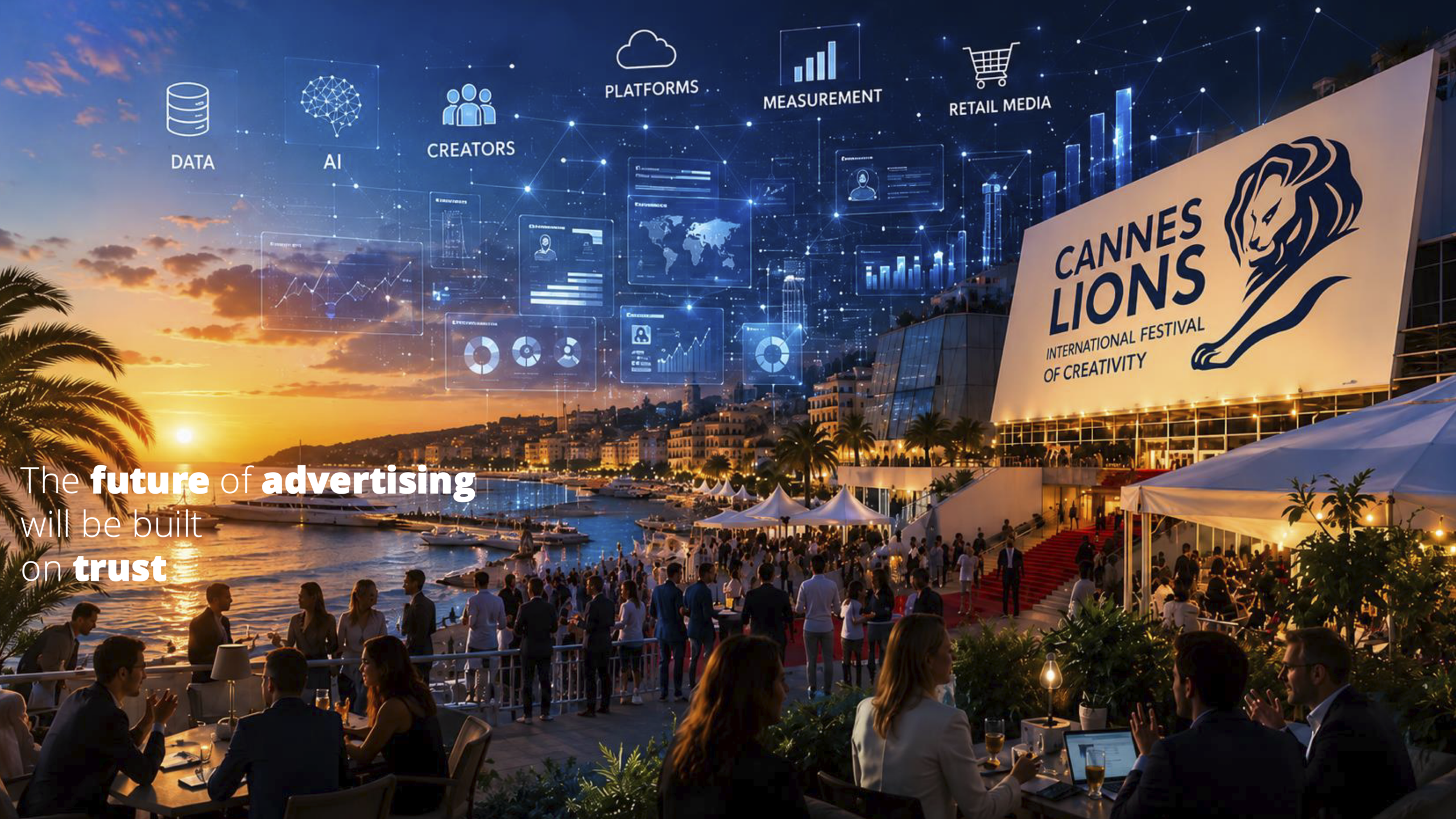
Every year, in mid-June, Cannes Lions becomes once again the symbolic centre of the advertising world. Since 1954, the festival has celebrated the most striking campaigns, craft, creativity, the boldness of brands and advertising’s ability to produce emotion, desirability and culture.
That function has not disappeared. It remains essential, in fact. Advertising needs strong ideas, narratives, distinctiveness and creative talent.
But Cannes no longer tells only that story.
As the festival has expanded far beyond the Palais, it has also become the reflection of another transformation: the shift of advertising value toward platforms, technological infrastructures, data, AI, creator ecosystems and measurement systems. In other words, the world’s largest celebration of creativity increasingly resembles a vast showcase of the players shaping the economic conditions of advertising itself.
That is precisely what this special edition of AdTrust sets out to examine.
Cannes is no longer only a creative festival. It is also a showcase of advertising infrastructures.
What is striking at Cannes today is not only the quality of the award-winning campaigns or the density of the conferences. It is the way the festival has turned into a parallel ecosystem made of beaches, rooftops, villas, ports, studios, immersive experiences and activations where commercial conversations matter as much as creative discussions.
Within this expanded space, the major American technology and advertising platforms occupy a particularly visible place. Meta, Amazon, TikTok, Google, Adobe, Microsoft, Spotify, Pinterest, Snap, Reddit, along with the major players in adtech and retail media, no longer come to Cannes merely to support the creative ecosystem. They install their formats, their demonstrations, their tools, their interfaces and their narratives around AI, creators, measurement, performance or commerce.
This shift matters.
For a long time, Cannes could be seen as the grand mass of the advertising idea. It now also resembles a full-scale marketplace of platforms, data, automation and activation environments — with a particularly visible presence of the players already capturing a growing share of the budgets once allocated to premium media.
This is not a reproach. It is a market fact.
The platforms have conquered dominant positions across essential layers: attention, distribution, targeting, measurement, commerce, creators, optimization and, increasingly, the orchestration tools themselves. It is therefore logical that they occupy Cannes. But their growing visibility says something deeper: the advertising battle is no longer fought only over ideas or inventory. It is also fought over the mastery of the invisible layers that organize performance.
And that raises a fundamental question for premium media.
Faced with the power of the platforms, European media are still looking for their own stage.
While Cannes has become a showcase of the major American infrastructures, it is not reducible to their dominance. What remains interesting about the festival is precisely that it still lets other geographies, other professional cultures and other visions of advertising come through.
For BuyTryShare, this is first visible in one very concrete place: RTL La Plage.
At a moment when part of the Croisette looks like a show of force by the global platforms, the presence of RTL AdAlliance is a reminder that a European media player can still exist at Cannes as something other than a mere spectator. For BuyTryShare, this presence is not abstract: RTL AdAlliance is among the rare European media players with which the project has already been able to open a concrete dialogue about other forms of value. This matters, not because it would prove anything on its own, but because it is a reminder that, amid the noise of the platform economy, some European media players remain able to explore trajectories other than the sole race for scale, data or automation.
In a different register, initiatives such as La French Connexion also play an interesting role. Not as a counter-power to the tech giants — that would be excessive — but as a rallying point for a French, and more broadly European, community that refuses to reduce Cannes to a mere theatre of platform activation. By bringing together brands, media, agencies, entrepreneurs and partners in a shared space, they are a reminder that there still exists a French, European, creative and relational anchoring in the industry — an anchoring that does not deny the international dimension of the market, but refuses to dissolve entirely within it.
These signals remain modest against the power of the major American ecosystems. But they are useful, because they show that the question is not only who occupies the most square metres on the Croisette. The real question is whether premium European media, sales houses, broadcasters and creative players can still defend a value proposition of their own in a market whose infrastructure is increasingly shifting elsewhere.
The point, then, is not to lament the dominance of the platforms. It is to understand what strategic space remains for premium European media in a market deeply reconfigured by them.
In other words: if the platforms win scale, data, automation and a growing share of the commercial stage, what remains distinctive about premium media?
If the platforms dominate the infrastructure, premium media may have to win back the battle for trust.
This is precisely the question that has run through the past six months of AdTrust.
Across 35 articles, this newsletter has explored the rise of consumer reviews, social proof, validation, participation, the transformations of the advertising market and the idea that a new layer of trust could emerge within media themselves. One conviction has gradually taken hold: attention is no longer enough.
In a market saturated with messages, the next battle is no longer fought only over reach, frequency or buying efficiency. It is also fought over credibility.
Consumers no longer simply receive messages. They verify them, compare them, comment on them, confront them with other experiences, and increasingly look for visible proof before deciding. And while the platforms excel at distribution, optimization and capturing attention, the question remains open on another terrain: that of visible trust, proof, editorial context and validation.
This may be where premium media can still recover a structural advantage.
Not by trying to imitate the platforms on their own ground. Not by dreaming of becoming European clones of Meta, Google or Amazon. But by asking what they can offer that the platforms cannot buy as easily: editorial context, a stronger relationship with the media brand, cultural credibility, and perhaps tomorrow the ability to host visible layers of proof, participation and validation within trusted environments.
That, at least, is the territory AdTrust intends to explore in its next cycle.
The first cycle made it possible to establish the diagnosis: the shift from exposure to validation, the rise of participating audiences, the transformation of reviews into potential assets, the emergence of a possible trust infrastructure.
The second will be closer to the ground. It will focus less on the general idea that trust matters — the market already knows that — than on the real conditions of its activation.
In other words, the coming editions of AdTrust will be organized around five more concrete questions:
- why does trust still have no budget line?
- why do good ideas die between the silos?
- what exactly is the economic value of proof?
- what does it take to make trust operational within a campaign?
- why is the first buyer almost always the hardest to convince?
Cannes remains a celebration of creativity. But this year, it also appears as a useful reminder: the future of advertising will not be shaped by creativity alone.
It will also be shaped by those who control the infrastructures, the data, the interfaces, the measurement systems — and perhaps tomorrow, the trust layer itself.
If Cannes is a reminder this week of who already controls attention, the next question for premium media may be even more decisive: who will know how to become credible again, at the very moment when consumers themselves now demand proof?