


For the past six months, AdTrust has explored a simple but increasingly important question: “What happens when trust becomes a strategic asset in advertising?”
Along the way, we have examined the growing influence of consumer reviews, the limits of attention as a standalone metric, the emergence of validation mechanisms, the rise of participation within media environments, and most recently, the idea that trust itself could become a new layer of advertising infrastructure. Taken individually, these topics may appear distinct. Together, however, they point toward the same conclusion: in a world saturated with messages, credibility is becoming as important as visibility.
This edition is slightly different from the previous ones. Rather than introducing a new concept, it marks a transition. Because at some point, every theory must be confronted with reality.
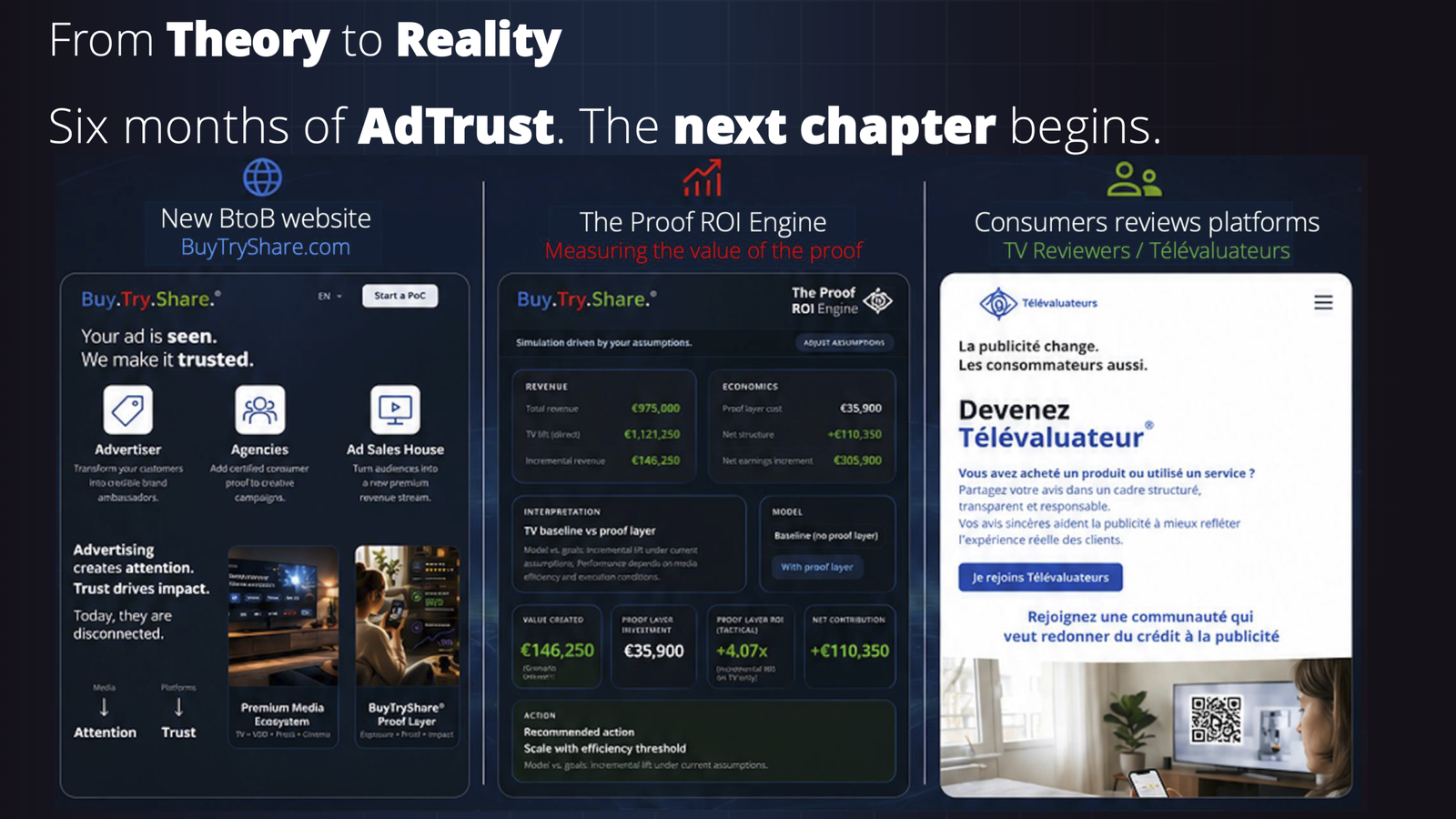
Over the past months, the ideas explored through AdTrust have progressively taken a more tangible form. BuyTryShare is now operating as a company, a first MVP has been launched, the Proof ROI Engine is live, and a new website has been built to support the next phase of the journey.
The question is therefore evolving. Until now, the objective was to understand whether these ideas made sense. From now on, the objective is to discover whether they create enough value to be tested by the market. This article reflects on that transition: from reflection to experimentation, from theory to reality.
What Six Months of Reflection Revealed
When AdTrust started this journey, the initial focus was relatively narrow. The objective was to explore the growing influence of consumer reviews and understand why they had become such a powerful factor in modern purchasing decisions.
The hypothesis seemed straightforward: consumers increasingly trust other consumers more than they trust brands. But as the research progressed, something unexpected happened.
The discussion moved beyond reviews. It became a discussion about advertising itself. About attention, about credibility, about media economics, about the growing gap between what brands say and what consumers believe.
Article after article, a recurring pattern emerged: the advertising industry has spent decades building increasingly sophisticated infrastructures to distribute messages, target audiences, optimize delivery and measure performance.
Yet one critical question remained largely unanswered: “What makes a message believable once it has been delivered?”
The more this question was explored, the more it became clear that reviews were not the real subject; trust was. Consumer reviews were simply one visible manifestation of a much larger phenomenon.
Consumers are no longer passive recipients of advertising. They verify, they compare, they search for validation, they seek proof before making decisions.
In that sense, the market may not be moving from advertising to reviews. It may be moving from messaging to validation, from attention to credibility, from exposure to proof.
And if that observation is correct, then the implications extend far beyond consumer reviews alone. They affect brands, agencies, media companies and perhaps the future architecture of advertising itself.
When an Idea Meets Reality
Ideas are easy to discuss in theory. Markets are less forgiving.
A concept can appear intellectually compelling, supported by research, aligned with consumer behavior and validated by industry trends. Yet none of this guarantees adoption.
At some point, every hypothesis faces the same test: will someone be willing to invest time, resources and budget to prove it works? This is where the journey now changes.
For six months, AdTrust explored the conditions that might justify a new approach to advertising: the rise of consumer validation, the growing importance of trust, the limits of attention-based metrics and the emergence of proof as a driver of decision-making.
The next step is no longer to understand these forces. It is to determine whether they can be translated into something operational. Over the past months, this transition has gradually taken shape:
- BuyTryShare is now operating as a company.
- A first MVP has been built.
- The Proof ROI Engine is live.
- A new website has been launched.
- The first discussions with advertisers, agencies and media companies are underway.
None of these milestones prove that the model will succeed. But they do something equally important: they transform an idea into a testable proposition. That distinction matters.
Too many concepts remain trapped in presentations, conferences and thought leadership articles. They generate interest, conversations and sometimes even enthusiasm, but never reach the stage where they can be challenged by reality.
The market ultimately acts as the final validator. Not because it is always right, but because it forces clarity. It reveals:
- whether a problem is important enough to solve,
- whether the proposed solution creates measurable value,
- whether the timing is right.
The coming months will therefore be different from the previous ones. The objective is no longer to refine a theory. The objective is to learn from experimentation, because every innovation eventually reaches a point where the question changes. From “Is this idea interesting?” to “Is this idea useful?”
What Happens If Trust Becomes Measurable?
One of the most interesting lessons from the past decade is that markets tend to value what they can measure.
- Attention became valuable when it could be quantified.
- Audience data became valuable when it could be activated.
- Attribution became valuable when it could be linked to outcomes.
The same question now emerges for trust. For years, trust has been treated as an intangible concept: brands invest heavily to build it, media companies rely on it to preserve their credibility, consumers use it to make decisions. Yet trust itself often remains difficult to observe, compare and quantify.
As a result, many organizations continue to manage it indirectly through proxy metrics such as awareness, consideration, preference or Net Promoter Score.
These indicators are useful, but they do not always answer a fundamental business question: what is the economic value of increased trust?
This question became one of the motivations behind the development of the Proof ROI Engine. Not because a model can perfectly predict reality — it cannot. But because hypotheses become more useful when they can be translated into scenarios, assumptions and measurable outcomes.
If trust influences attention, consideration and conversion, then it should be possible to estimate its potential impact, not as certainty, but as a framework for discussion. This distinction is important.
The objective is not to claim that trust automatically generates results. The objective is to understand under which conditions trust can create value, for whom, and to what extent.
In many ways, this reflects a broader evolution taking place across the industry. Advertising is progressively moving away from assumptions and toward evidence. From intuition toward experimentation, from declarations toward validation. And perhaps that is where the next phase begins.
Not with the certainty that a new model will succeed, but with the willingness to test whether credibility itself can become a measurable driver of media performance.
Because if trust can be measured, activated and improved, it stops being a purely qualitative concept — it becomes an economic variable. And economic variables tend to reshape markets.
The Next Chapter Begins
The purpose of AdTrust was never to predict the future. Its purpose was to ask questions that the industry may need to confront sooner rather than later. What happens when:
- consumers trust people more than brands?
- validation becomes as important as visibility?
- credibility becomes a competitive advantage?
- trust itself starts behaving like an economic asset?
Over the past six months, these questions have shaped every article published in this series. Some conclusions remain open to debate, others will undoubtedly evolve as technology, regulation and consumer behavior continue to change.
But one observation appears increasingly difficult to ignore. The advertising industry is entering a new phase — not because advertising is disappearing, not because media are losing their relevance, but because audiences are becoming more active participants in the process.
They do not simply receive messages: they evaluate them, they verify them, they discuss them. And ultimately, they contribute to the credibility of brands themselves.
In that context, trust is no longer just a consequence of communication. It is becoming part of the communication system itself.
Whether this evolution leads to new formats, new measurement frameworks or entirely new business models remains to be seen. The market will decide. That is precisely what makes the next stage so interesting.
Until now, AdTrust has been a space for reflection. The next chapter will increasingly be about observation, experimentation and learning. Because the most important question is no longer whether these ideas are intellectually appealing. It is whether they create measurable value in the real world.
And there is only one way to find out. To test them. The journey continues.