


Some innovations seem to have every ingredient for success. They meet a real need, create value, and often draw the interest of many players. Yet many take years to actually reach their market.
Contactless payment is a good illustration. The technology existed, but its adoption required banks to issue the cards, networks to align their standards, merchants to upgrade their terminals, and consumers to change their habits.
So the problem doesn’t always lie in the idea itself. Sometimes it lies in how organizations and ecosystems are structured. When an innovation crosses several areas of expertise, several departments, or several partners, it can quickly end up without a true owner.
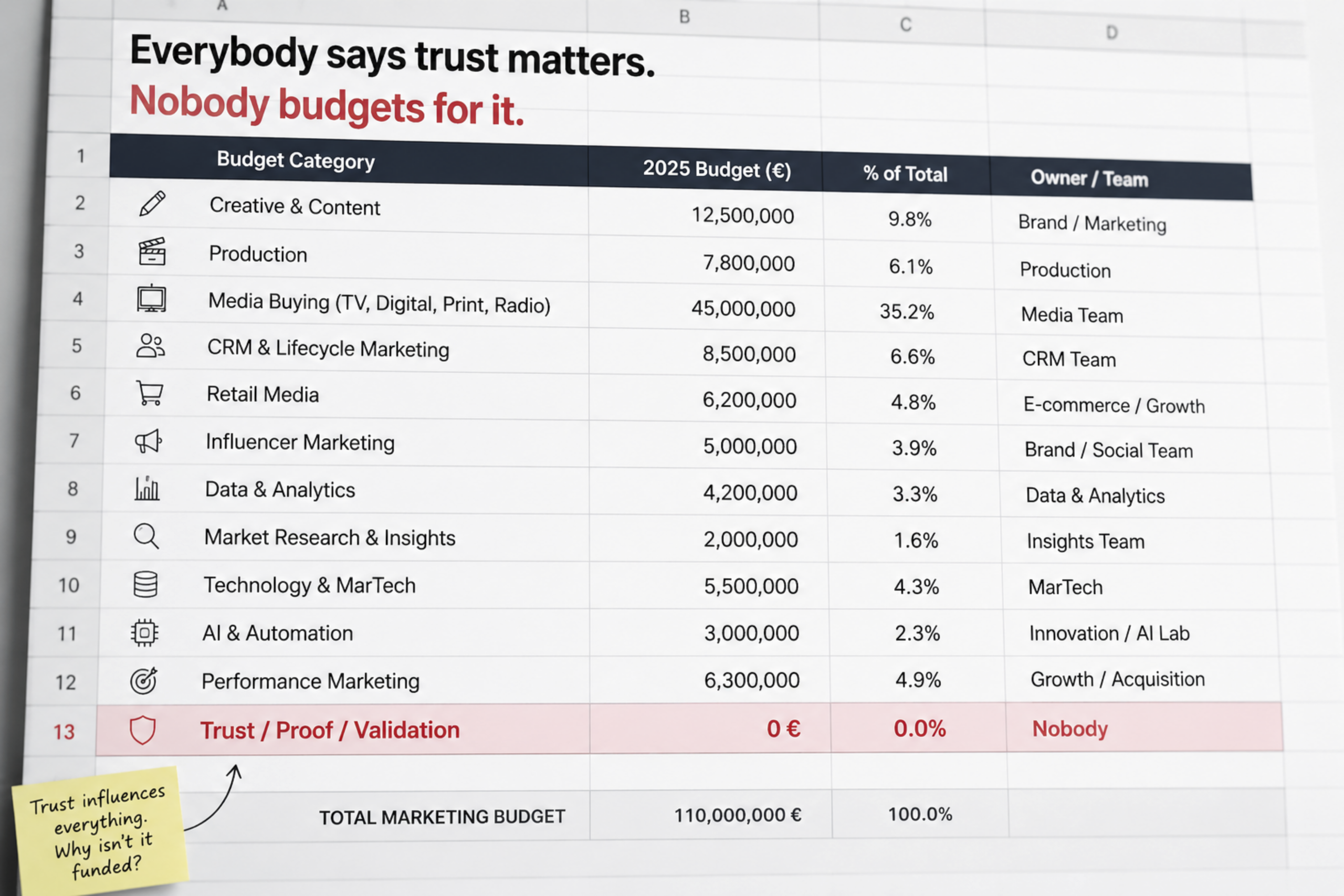
What if some good ideas don’t disappear for lack of value, but because no single player holds, on its own, the means — or the mandate — to make them adopted?
1. Organizations are built to manage expertise. Not cross-functional ideas.
Large organizations are built around a simple logic: split responsibilities in order to develop ever sharper expertise.
This specialization isn’t accidental. It’s the consequence of growing market complexity. It also answers a demand for performance. As each function grew more complex, it became impossible for a single team to master the entire advertising value chain.
Twenty years ago, a marketing director could still oversee a campaign built mainly around a TV film, a press plan, and an outdoor placement.
Today, a single campaign can simultaneously mobilize television, digital, retail media, social media, content creators, CRM, e-commerce, data, artificial intelligence, research, brand safety, and the regulatory issues tied to personal data.
Facing this complexity, organizations naturally specialized.
- Marketing steers the brand.
- Communications builds the messaging.
- Media teams optimize investment.
- CRM develops the customer relationship.
- Consumer Experience teams improve the journey.
- Data and AI teams use data to sharpen decisions.
- Legal departments secure compliance.
- Research institutes provide independent performance measurement.
- Creative agencies imagine campaigns.
- Media agencies orchestrate investment.
- Sales houses value their inventory and commercialize their audiences.
This specialization is a formidable source of efficiency. It lets each function build expertise that no single person could reasonably master alone.
No one would ask a creative agency today to build an econometric model. Nor would anyone expect a research institute to design an ad campaign.
This specialization also serves another, often less visible purpose: risk management. In an industry where global advertising investment runs into several hundred billion euros a year, decisions rarely rest on a single person. They rely on recognized expertise, specialized partners, and independent third parties able to inform or de-risk the choices being made.
- A media agency doesn’t just buy space. It informs trade-offs, de-risks investments, and puts its credibility behind the recommendations it makes.
- A creative agency doesn’t just produce campaigns. It helps brands limit creative risk.
- Likewise, research institutes, consultancies, and independent measurement experts help validate hypotheses before, during, or after a campaign.
Specialization, then, doesn’t just build skill. It’s also a collective risk-reduction mechanism.
This division of roles is therefore not just logical — it’s indispensable.
But this organizational structure also has a limit. The most promising innovations rarely respect the boundaries organizations have built for themselves.
They cross several areas of expertise, several departments, and often several companies. They require shared responsibility, and coordination between players who share neither the same objectives, nor the same budgets, nor the same success metrics.
Organizations were rarely designed for that. They excel at managing expertise. Their real challenge begins where value sits between functions.
2. When an innovation belongs to several functions, it often ends up belonging to none of them
Not all innovations face the same adoption difficulties. Some fit naturally within an already identified function. They quickly find a sponsor, a budget, and a decision process.
Others, by contrast, cross several areas of expertise at once. They touch brand, creative, media, research, customer relations, data, and compliance simultaneously.
The growth of Retail Media is a good illustration. It belongs exclusively to no one — not media teams, not e-commerce, not CRM, not data. Its rise depended precisely on the ability of these different areas of expertise to coordinate their decisions around a shared objective.
The arrival of generative AI illustrates the same phenomenon. Should it be led by IT, Data leadership, marketing, the business units, HR, or innovation leadership? In many companies, that question is still being fought over.
The wider the scope grows, the harder a simple question becomes to answer: who should actually own this innovation? The CMO? The media director? Consumer Insights? CRM? Communications? Legal? Or an innovation director, where one exists?
In most cases, everyone recognizes part of the value. But no single player holds, on its own, the legitimacy, the budget, or the performance metrics to make the call.
The more value an innovation creates across functions, the less obvious it becomes who should adopt it first.
Every organization has a clear map of its responsibilities. Far more rarely does it have a map of its cross-functional topics.
This isn’t a lack of interest, nor resistance to change. It’s simply a consequence of how responsibilities are distributed inside organizations.
A cross-functional innovation doesn’t just challenge habits. It challenges the boundary between functions itself.
And this is exactly where trade-offs get harder. A decision no longer just means choosing a solution. It also means determining who becomes responsible for it… and who agrees to carry the risk.
3. Silos don’t stop at the company’s walls
The difficulties faced by cross-functional innovations aren’t only explained by advertisers’ internal organization. They also stem from how the entire advertising industry has progressively structured itself.
Over the decades, the ecosystem has specialized around players whose expertise has become increasingly complementary.
- Creative agencies imagine campaigns.
- Media agencies build investment strategies and arbitrate media plans.
- Sales houses commercialize and value their inventory.
- Research institutes measure performance and bring an independent view.
- Platforms build their technology and advertising environments.
- Consultancies support organizational transformation.
This specialization is a formidable strength. It lets each player deepen its expertise, innovate in its own domain, and bring real added value to its clients. It also helps limit risk by relying on recognized, complementary expertise.
But, as within companies, this structure has a limit too. The most promising innovations don’t always fit within a single area of expertise. They can touch creative, media, measurement, data, customer experience, technology platforms, and regulatory compliance all at once.
A new question then emerges: who has the legitimacy to initiate the move?
The advertiser expressing a new need? The creative agency imagining new formats? The media agency steering investment? The sales house commercializing the space? The research institute validating the results? The tech vendor building the solution? Or the consultancy guiding the transformation?
In many cases, everyone holds part of the answer. But no single player holds, on its own, the responsibility or the legitimacy to carry the whole.
It is precisely in this space between areas of expertise that some innovations struggle to find their place.
The advertising industry has become extraordinarily good at organizing expertise. It remains more complex when it comes to organizing what connects that expertise.
When an innovation manages, despite everything, to bring these different players together, one final question remains: how can its value be demonstrated in a way that’s shared and credible?
4. An innovation only becomes a market once an ecosystem agrees to carry it
Disruptive ideas only take hold once a group of players progressively decides to adopt them. Payment standards, contactless, Retail Media, or generative AI didn’t take hold because a single company decreed them.
They developed because advertisers, tech vendors, agencies, institutes, regulators, and sometimes standards bodies progressively converged on the same direction.
An innovation then stops being seen as an isolated initiative. It becomes a new language shared across an entire market.
Recent history is full of examples.
The QR code, created in 1994, stayed confined to a handful of industrial uses for decades. It took the arrival of smartphones, native code readers built into cameras, and the acceleration of use during the Covid-19 pandemic for it to become an everyday standard.
Electric vehicles follow a similar logic. Their development doesn’t depend on carmakers alone. It also relies on energy providers, charging operators, local authorities, regulators, battery manufacturers and, of course, consumers. Improvements in battery technology, the build-out of charging infrastructure, and its interoperability have progressively removed several barriers to adoption.
In both cases, it wasn’t a technology that created the market. It was an ecosystem. That shift matters.
An innovation no longer just needs to convince a decision-maker. It has to progressively convince a market.
This also explains why some ideas take years to emerge. Their challenge isn’t only technological or commercial. It’s organizational too. Before transforming a market, they have to succeed in aligning the players that make it up.
That alignment requires one essential condition: the ability to demonstrate the value created in a way that’s shared and credible.
Without a common language, a shared reference framework, and a recognized measure, even the best ideas struggle to become standards.
Conclusion
Silos aren’t a design flaw. They’re the logical result of an industry that has become ever more expert.
But when value is created between functions, companies, or disciplines, a new form of coordination becomes essential.
The most promising innovations aren’t always the ones with the best technology. They’re often the ones that manage to unite an ecosystem, speak a common language, and demonstrate their value in a way shared and credible enough for everyone to agree to become part of it.
An innovation never becomes a market simply because it works. It becomes a market when an entire ecosystem agrees to carry it.