




Why the ‘bottom of the funnel’ is impoverishing brands...
...and how customer evidence can reconcile creativity, traditional media and performance. For the past ten years, marketing has sought to measure, optimise and convert everything – CPA, ROAS, last click, real-time attribution. On paper, it made sense. In reality, this choice is now having a massive negative effect: the gradual impoverishment of brands. A plea for a return to favour for traditional media, augmented by social proof.
Stéphane LE BRETON
12/19/20256 min read
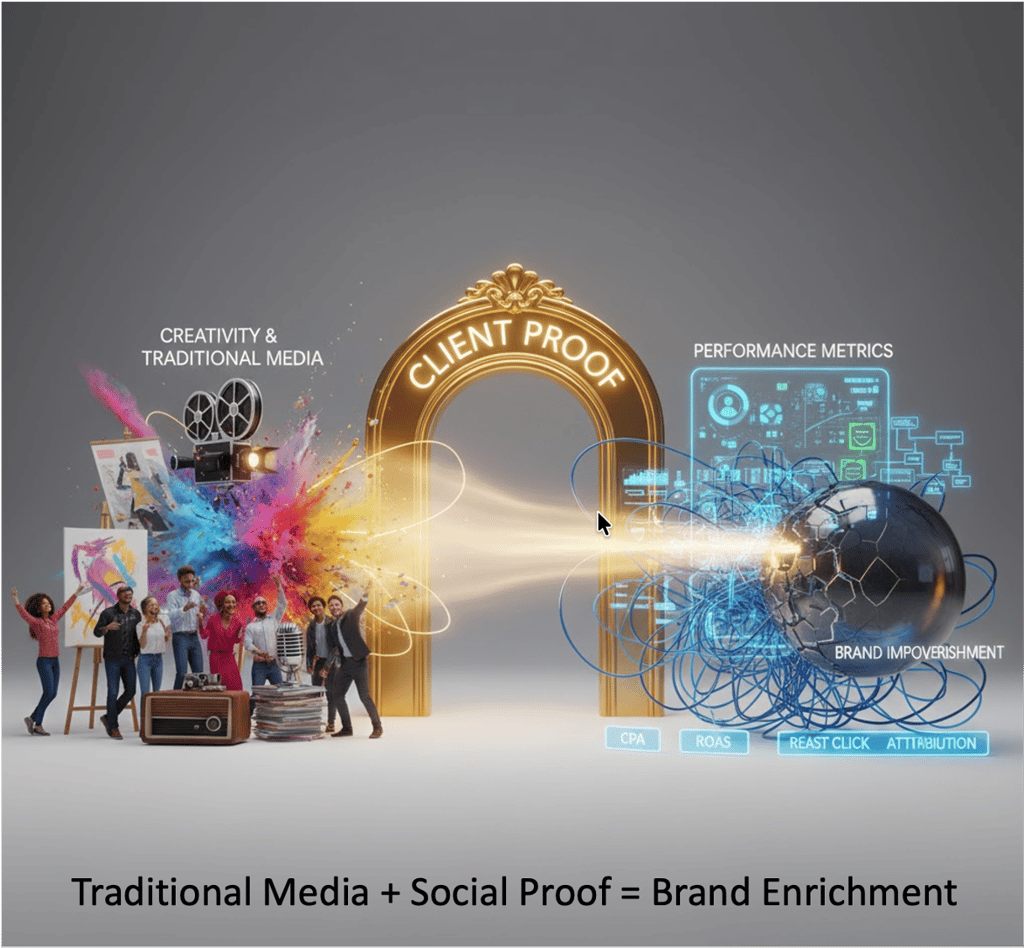
The bottom of the funnel did not “win”. It was over-invested.
For more than ten years, the work of Les Binet and Peter Field has documented a counterintuitive but now well-established phenomenon: brands that over-invest in the short term at the expense of the long term end up paying more for each point of performance, while gradually weakening their brand equity.
In other words, the bottom of the funnel did not become dominant because it was inherently superior. It became dominant because it was easier to measure, quicker to justify, and more reassuring in a high-pressure environment.
In Media in Focus and Selling Creativity Short, Binet and Field clearly demonstrate that:
the short term (activation, promotion, tactical targeting) is effective for generating immediate sales,
the long term (emotional creativity, mass media, narrative consistency) is the main driver of sustainable growth,
and that upsetting this balance — by sacrificing the long term — automatically leads to a destruction of value in the medium and long term.
This point is fundamental: performance has never been the enemy of the brand. It is its exclusive overinvestment that poses a problem. By reducing marketing to what is immediately measurable — CPA, ROAS, last click, real-time attribution — many brands have gradually abandoned what cannot be measured instantly, but nevertheless creates most of the value: desirability, memorability, brand preference.
The result is paradoxical:
In the short term, indicators appear to be improving.
In the medium term, acquisition costs are increasing.
In the long term, the brand is eroding, becoming interchangeable and dependent on activation.
As Binet and Field show, ‘short-term thinking sells, long-term thinking grows. Confusing the two destroys value.’
At BuyTryShare, we firmly believe that customer proof is what allows us to become measurable again in the long term, without distorting it.
Performance has never been the enemy of the brand. The problem lies in reducing marketing to what is immediately measurable...
And it is precisely this imbalance — documented for over a decade — that largely explains the current tensions between creativity, traditional media and business demands.
Traditional media have not lost their effectiveness
They have lost touch with the evidence. The relative decline in investment in traditional media is often interpreted as a loss of effectiveness.
This is a simplistic interpretation — and largely incorrect. Academic research and market studies show that television, print media and cinema remain the most powerful media for building brand awareness, recall and preference. They continue to operate where pure performance fails: in building long-term relationships.
The problem, then, is not that these media no longer work. The problem is that they have been gradually disconnected from the moment of validation. In other words, they still trigger emotion, interest and desire... but they no longer offer immediate continuity to proof.
In the past, this disconnect was not an issue. Advertising enjoyed implicit credibility. The brand spoke, and the message was generally accepted.
Today, that capital has eroded. Contemporary consumers are neither hostile to advertising nor passive. They have become reflexively suspicious. They watch. They listen. But they check.
And when advertising offers no explicit path to proof, it is circumvented. Not rejected — but simply incomplete.
This is precisely what explains a paradox that has been observable for several years:
Traditional media continue to generate emotional impact,
but struggle to defend their business contribution in the face of channels perceived as more ‘actionable’,
even though their role in brand building remains decisive..
In reality, they have been locked into an artificial opposition:
on the one hand, mass media for image,
on the other, platforms for proof and performance.
This separation has benefited the platforms. But it has weakened the ecosystem as a whole.
The real issue, then, is not creativity. Nor is it media power. Nor even audience fragmentation. The real issue is the lack of a bridge between exposure and validation.
When advertising triggers a desire without offering the possibility of immediate verification, it leaves the consumer alone with their doubts — and automatically loses some of its value.
The paradox is therefore as follows:
Traditional media remain essential for brand building,
but are increasingly less recognised as business drivers,
because they no longer incorporate the logic of proof that has become central to the purchasing process.
This is not inevitable. It is a problem of design, not relevance.
At BuyTryShare, we start from a simple belief: proof should not replace the power of traditional media. It should complement it.
Advertising is not intended to become a place for consultation. But it can — and must — once again become the moment when credibility is at stake. By reconnecting mass media with customer evidence, it becomes possible to:
preserve their emotional and narrative role,
while giving them measurable continuity towards validation.
Traditional media have not lost their value. They have lost a link. And it is precisely this link — between creation, exposure and proof — that now determines their ability to remain central to marketing strategies.
What platforms understood before anyone else:
immediate verifiability.
The reason why platforms have gradually captured an increasing share of advertising value is not solely because they are more efficient, more creative or more technologically innovative.
This is primarily because they understood a simple reality very early on: in a world of mistrust, any promise must be immediately verifiable. On platforms, advertising is never isolated. It is systematically surrounded by validation signals:
visible reviews and ratings,
comments,
recommendations,
user-generated content
instant exploration possibilities.
Exposure and proof coexist in the same environment. This continuity changes everything.
When an advertisement attracts interest on a platform, consumers do not need to leave the site to check it out.
The proof is there, accessible, integrated, sometimes even imposed. It is not so much a question of trust in the platform itself. It is a question of immediately reducing doubt.
The platform does not ask consumers to believe. It allows them to verify.
This is precisely what has made these environments so effective in terms of performance. Not because advertising is more persuasive there, but because the path between intention and validation is short, fluid and measurable.
Conversely, traditional media have long operated on a different model:
exposure here,
verification elsewhere,
decision later.
This model was viable as long as advertising enjoyed implicit credibility. That is no longer the case today. However, it would be wrong to conclude that platforms have ‘won’ through creative or cultural superiority. They have won because they have been able to meet an expectation that has become central: the ability to validate a promise without friction.
But this gain has come at the cost of several well-known adverse effects:
standardisation of messages,
constant pressure to deliver short-term results,
increased reliance on activation,
and growing difficulty in building truly distinctive brands.
In other words, platforms excel at conversion. They are much less effective at building sustainable brand value.
The real challenge, therefore, is not to imitate platforms. Nor is it to transform traditional media into transactional environments. The real challenge lies elsewhere: it consists of reintroducing immediate verifiability where emotion, desirability and preference are built.
That is to say, at the heart of mass media. When television, press or cinema advertising triggers strong emotions but offers no explicit access to evidence, it leaves consumers suspended between interest and doubt.
Conversely, when a creative message is immediately accompanied by credible evidence, it does not lose its emotional power. It gains legitimacy. This is where the historical separation between branding and performance shows its limitations.
Verifiability is not an attribute of the bottom of the funnel. It is a cross-cutting requirement that has become structural in all decision-making processes.
Platforms understood this before anyone else. Traditional media can now reclaim it — without giving up what makes them strong.
At BuyTryShare, we start from a simple observation: proof is not the enemy of creativity. It has become its prerequisite for credibility.
By reconnecting the emotional power of traditional media with certified, immediately actionable customer evidence, it becomes possible to:
maintain the impact of the top of the funnel,
meet contemporary validation requirements,
and finally move beyond the sterile opposition between image and performance.
Platforms have understood the importance of verifiability. Traditional media have mastered the art of creating symbolic value. The challenge now is to bring the two together.
And it is precisely here that the future of advertising effectiveness is being played out.
Finally reconciling evidence, creativity and value
The debate between branding and performance is a false one. What has weakened brands in recent years is neither creativity, nor moderation, nor the pursuit of ROI.
It was separating emotion from evidence, exposure from validation, the long term from the measurable. The bottom of the funnel did not win. It was overinvested in, for lack of anything better.
Traditional media have not lost their power. They have lost their continuity towards evidence.
Platforms did not triumph through creative superiority.
They simply understood, before others did, that every promise had to be verifiable.
The challenge is therefore not to choose between image and performance. The challenge is to make the top of the funnel credible, measurable and actionable again, without distorting it. This is precisely the role of customer proof.
At BuyTryShare, we firmly believe that certified social proof is neither a gimmick nor just another marketing tool. It is the missing piece that allows traditional media to regain their full economic value, while respecting their cultural and creative role.
In an age of mistrust, advertising will not win by promising more. It will win by allowing verification.
And this is exactly where BuyTryShare comes in.
Our commitment
Reviving trust in brand advertising through innovation.
CONTACt
info@buytryshare.com
+33 6 83 53 70 41
© 2025. SLB consulting. All rights reserved.