



Why certified reviews are becoming the ultimate weapon against advertising mistrust
What if the next advertising revolution didn't come from creatives... but from customers? In 2025, an advert without proof looks like an empty promise. In a world where attention is fragmented and trust is eroding, certified reviews give messages weight, reconcile credibility and performance, and offer the media a concrete response to the rise of platforms.
Stéphane LE BRETON
12/12/20256 min read
This graph does not say ‘opinions have no place in advertising’
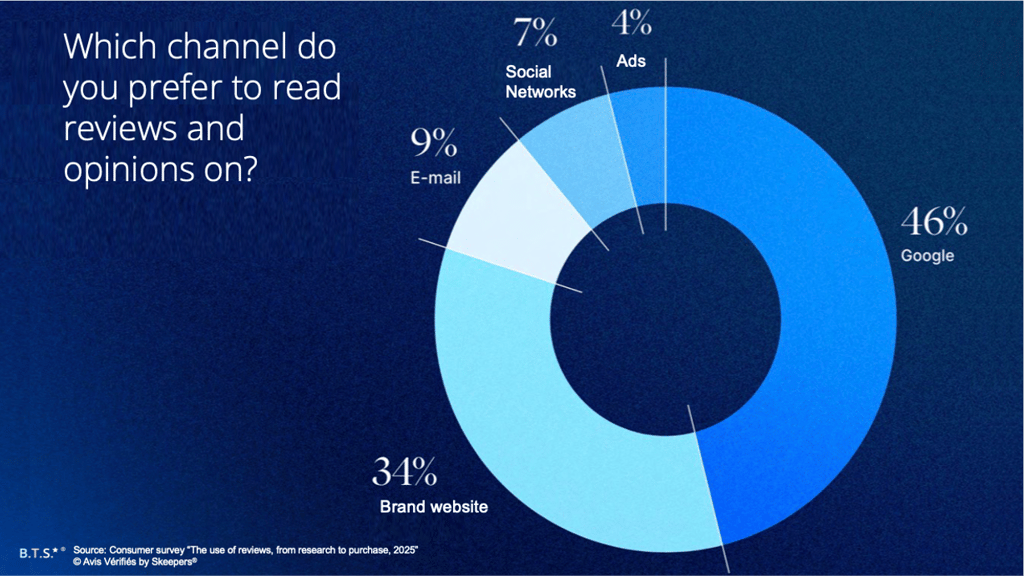
At first glance, this graph may seem counterintuitive to those who advocate for the integration of customer reviews into the advertising world. Only 4% of respondents cite advertising as their preferred channel for reading reviews, compared to 46% for Google and 34% for the brand's website. Some will see this as a definitive condemnation: ‘Reviews have no place in advertising.’
It's a quick read. And above all, it's a misreading. What this graph actually measures is not the usefulness of reviews in advertising, but where consumers go to find proof when they are already in decision-making mode. In other words, it answers the question: ‘When I want to check something, where do I go?’ The answer is perfectly logical:
Google to compare and cross-reference sources,
the brand's website to confirm the offer,
sometimes email or social media,
and very rarely advertising, which historically has never been designed as a space for consultation.
The classic mistake: confusing the place of evidence with the time of evidence. This is where the fundamental confusion lies.
A place of discovery is a space designed for exploring, reading, comparing and delving deeper.
A moment of discovery is a moment triggered by an exhibition, an emotion, a promise or a desire.ie.
Advertising has never been — and never will be — a place for proof in the strict sense of the word. No one expects to read dozens of customer reviews in a television advert, a newspaper page or a poster. And that's fine.
But advertising is, by its very nature, the moment when the need for proof arises. It is precisely when an advertisement works — when it captures attention, arouses interest, creates a projection — that the modern consumer's reflex kicks in:
‘Okay... but is it true?’
‘Have others experienced it?’
‘Can I verify it?’
What this graph really reveals is that advertising is bypassed if it does not trigger access to proof. The key figure is therefore not just 4%. The key figure is what it implies. It shows that:
Advertising alone is no longer considered credible by default.
Consumers have developed a systematic validation reflex,
and this reflex is exercised elsewhere... immediately after exposure.
Advertising is not rejected. It is bypassed when it offers no path to proof. It is not a problem of creativity, format or GRP. It is a problem of cognitive continuity between the message and validation.
So the real question is not ‘where do people read reviews?’ It is much more strategic: Does advertising allow access to evidence at the exact moment when interest is triggered?
This is where everything comes into play. And this is precisely where the intelligent integration of certified reviews — not as content to be consumed, but as a signal of credibility and a gateway to verification — becomes decisive.
Advertising should not host the evidence. It should activate the evidence reflex at the right time, in the right places, in a fluid, explicit and measurable way.
It is this shift—from isolated messages to verifiable messages—that is redefining advertising effectiveness today. And this graph, far from invalidating this approach, is one of the clearest demonstrations of it.
BuyTryShare does not include reviews in advertising
It activates them through advertising. This is undoubtedly the most misunderstood — yet most fundamental — aspect of the BuyTryShare approach. Contrary to popular belief, BuyTryShare does not seek to transform advertising into a review platform. Television does not become a Tripadvisor. The press does not turn into a comment forum.
Above all, advertising does not become a place for consultation. It remains what it has always been, and what it does best: a trigger.
Advertising as a cognitive bridge, not as a destination
In the modern consumer's thought process, advertising plays a very specific role:
It creates the spark.
It captures attention.
It projects a use.
It triggers a desire.
But the moment this interest arises, a second mechanism automatically kicks in: ‘Can I verify this?’
This is where most advertising campaigns end. The message is broadcast... then left alone, with no follow-up.
BuyTryShare comes into play precisely at this point: between exposure and verification. Advertising does not become proof. It becomes the point of access to proof.
Why format, duration and design are strategic
This role of ‘cognitive bridge’ requires very specific choices — and commitment.
A short format (5 seconds)
Because it is not a matter of lengthy persuasion, but of pointing things out.
Evidence does not need a speech. It needs credible evidence.
A certified average mark
Because it acts as an immediate cognitive shortcut.
A simple, universal signal that can be understood in a fraction of a second.
A real customer quote
Because he embodies proof.
He does not speak ‘on behalf of the brand’, but on behalf of a peer.
An explicit promise: ‘genuine reviews, verified customers’
Because trust can no longer be assumed. It must be expressed.
A visible and unapologetic QR code
Not a technological gadget, but an interface that makes advertising verifiable again.
Because it embodies the call to action: ‘Want to check? You can. Right now.’
It is not a technological gadget. It is a mental interface between mass media and individual action.
BuyTryShare does not compete with Google or the brand's website
He feeds them with an already warm intent. This is a fundamental point: Google remains the natural place for verification, and the brand's website remains the space for reassurance and conversion.
BuyTryShare does not seek to replace them. It directs users towards them, but with one major difference: the intention is no longer cold, it is triggered, contextualised and measurable.
Consumers do not ‘stumble upon’ a review page. They arrive there because a trusted media outlet has triggered their need for proof. That is what makes the difference:
an interactive exposure,
an intentional impression
a measurable GRP signal.
The real paradigm shift: from ‘declarative’ advertising to ‘verifiable’ advertising
Historically, advertising operated on a declarative model: ‘This is what we say about ourselves.’ The BuyTryShare model introduces a subtle but radical shift: ‘This is what our customers say — and here's how you can verify it.’
This is not a break with creativity. It is an extension of its credibility: advertising continues to inspire dreams, evidence provides reassurance, and the media becomes the link between the two.
In summary
BuyTryShare does not incorporate reviews into advertising. It incorporates the ability to verify into the advertising itself. And in a world where mistrust has become a reflex, this simple shift — from isolated messages to verifiable messages — profoundly changes the nature of advertising effectiveness.
The real problem with traditional advertising revealed by this graph
It is no longer trusted by default. The most revealing figure in this graph is not Google's 46% or the brand website's 34%. It is the 4% attributed to advertising. Not because it ‘condemns’ advertising, but because it reveals a much deeper reality: advertising is no longer considered a credible source in itself.
It is not a crisis of creativity.
It is not a crisis of formats.
It is not even a crisis of audience.
It is a crisis of evidence.
Aujourd’hui, un message publicitaire est perçu comme une affirmation par défaut. Et toute affirmation appelle une vérification.
Today, an advertising message is perceived as a default assertion. And every assertion calls for verification.
This is precisely what explains a phenomenon that has been observed for several years in the United States — and is beginning to occur in Europe: the structural decline in TV advertising revenue, while Google, Meta, Amazon and TikTok capture most of the growth. Why is this?
Because platforms have long since incorporated what traditional advertising has ignored:
immediate access to evidence,
measurement of intent,
continuity between exposure and action.
Traditional media, meanwhile, remained stuck in a model where attention was supposed to be enough.
This graph puts an end to that illusion. It shows that without actionable proof, advertising is automatically bypassed. It may trigger an emotion... but it loses the battle for credibility.
And this is precisely where BuyTryShare provides an industrial solution.
Advertising must no longer just capture attention
It must inspire confidence. This graph does not call advertising into question. It simply reminds it that it must become relevant again. In 2025:
advertising is no longer a place of proof,
but it remains the key moment when the need for proof arises.
Certified reviews are not there to ‘look good’ in an advert: they are there to make the message verifiable, immediately, simply, without friction. BuyTryShare does not seek to change existing habits. It relies on an already established reflex: see → doubt → verify
The difference is that he:
anticipates this reflex,
organises it,
channels it,
and makes it measurable for brands and media alike.
We are entering an era in which:
All serious advertising will need to offer a path to validation,
any exposure without proof will be perceived as incomplete,
and media capable of monetising trust, not just attention, will regain the upper hand.
In this context, BuyTryShare is not an anomaly. It is a logical evolution. Because tomorrow's advertising will not win by speaking louder. It will win by proving itself better.
In an age of mistrust, advertising will no longer win by promising more, but by providing access to proof.
Our commitment
Reviving trust in brand advertising through innovation.
CONTACt
info@buytryshare.com
+33 6 83 53 70 41
© 2025. SLB consulting. All rights reserved.