




Why attention is no longer enough in advertising
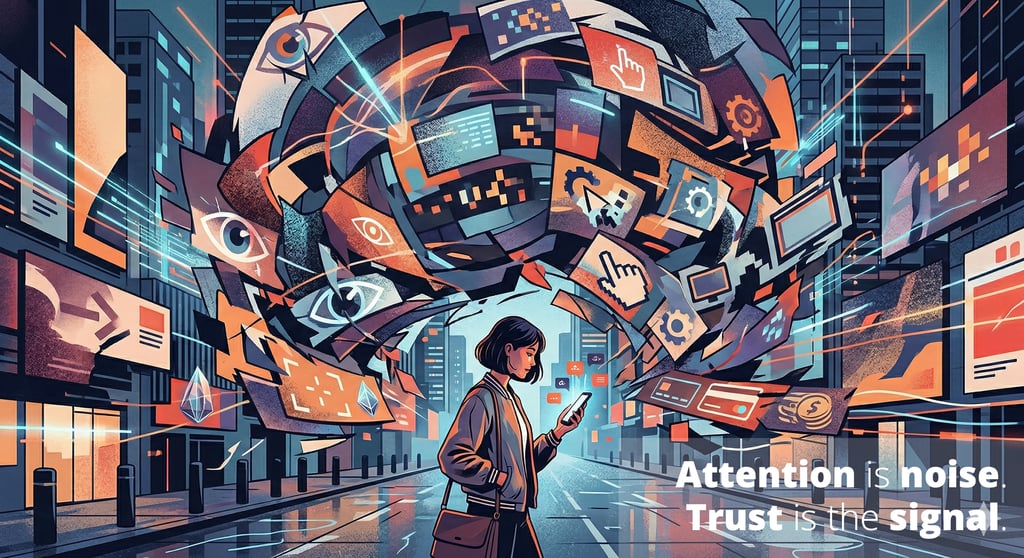
For twenty years, advertising has been built around a central objective: to capture attention. More prints, more formats, more channels, more visibility. This logic has profoundly transformed the industry and enabled a massive expansion of broadcasting capabilities. But in an environment that has become saturated, a question is beginning to emerge: what if attention is no longer enough? Because when everything catches the attention, it gradually loses its value. What is becoming rare is no longer the exposure, it is the real attention. And perhaps even more: credible attention. The attention makes visible. Trust makes you credible.
Stéphane LE BRETON
3/29/20265 min read
The explosion of the attention economy
Over the past two decades, the media and advertising industry has gradually structured itself around a resource that has become central: human attention.
With the rise of digital, social media, online video and connected TV, advertising exhibition opportunities have multiplied on an unprecedented scale. Brands have never had so many opportunities to reach their audiences.
According to several industry estimates (including WARC and Statista), global advertising investment reached $900 billion in 2024, confirming continued growth driven by digital and video
But this growth has also profoundly transformed the very nature of attention. It is no longer just a rare resource to capture, it has become an industrial resource to buy, optimize and arbitrate.
This transformation was particularly well described by Bruno Patino in The Goldfish Civilization, where he explains how the digital economy is gradually fragmenting our ability to concentrate in favor of a logic of permanent capture of micro-moments of attention.
In this model, competition is no longer limited to the quality of content or messages. It's about the ability to interrupt. But in an environment where everything seeks to capture attention, attention itself becomes a resource under pressure. Herbert Simon already explained it: in an information-rich economy, scarcity no longer concerns information, but the human attention available to process it.
Today, this observation takes on a very concrete dimension in the advertising economy. It is no longer just the ability to diffuse that creates value, but the ability to emerge in a saturated environment. In an economy where attention becomes abundant, its quality becomes decisive. And, in a world of fragmented attention, credibility may become one of the few factors that can stabilize it.
Not all attention has the same value
If the advertising economy has long been built around the ability to generate impressions, an important evolution is beginning to appear: not all exhibitions produce the same attention.
Advertising printing does not guarantee real attention: a video viewed for a few seconds does not guarantee memorization, a click does not guarantee an intention. Several recent works on advertising attention (notably those of Lumen Research, Amplified Intelligence or Karen Nelson-Field) show that the actual duration of attention given to many digital formats remains extremely limited. In some cases, it is measured in seconds, or even in fractions of seconds.
These observations do not call into question the effectiveness of digital advertising. But they introduce an essential nuance: attention is not uniform. It varies according to:
the media context
the level of confidence in the environment
quality of user experience
the time of exposure
In other words, not all attention has the same economic value.
This development marks an important transition. For a long time, the dominant logic was quantitative:
how many impressions?
how many views?
how many clicks?
But gradually, a qualitative logic emerges:
what real attention?
in what context?
with what level of credibility?
In this context, the strategic question could evolve. It's no longer just: how many people have seen the ad? But: how many have actually paid attention to it? Any impression is not an attention. All attention is not a trust.
Attention without confidence becomes noise
If not all attention has the same value, it is also because it does not produce the same effects. An advertisement can be seen, it can even catch a few seconds of attention.
But if the context in which it appears is perceived as not very credible, saturated or interchangeable, this attention loses part of its value, it does not disappear: it deteriorates.
In an environment of low confidence, attention becomes more fragile, more volatile, more defensive. The message can emerge visually without being mentally anchored, it can be exposed without being really integrated.
In an environment of low confidence, attention becomes more fragile, more volatile, more defensive. The message can emerge visually without being mentally anchored, it can be exposed without being really integrated.
The same message does not have the same scope depending on whether it appears:
in an environment perceived as credible
in a flow saturated with stresses
next to questionable content
or within an identified editorial universe.
In other words, attention only becomes effective when it is within a framework that is credible enough to allow the message to be received, not simply seen.
In the most saturated environments, advertising competes not only with other messages, but with generalized cognitive fatigue; the consumer no longer filters only according to interest, he also filters according to the trust he gives to the environment. And when this confidence is low, the advertising message tends to reach an indistinct mass: that of noise.
In this logic, scarcity no longer lies only in the attention available: it lies in the ability to transform this attention into credible perception. That is why the value of a media environment can no longer be measured solely by its ability to generate exposure: it must also be assessed in terms of its ability to give weight to the message. Because an advertisement seen without trust is often an advertisement simply crossed. Attention makes exposure possible, confidence makes impact possible.
The emergence of qualified attention
Faced with the saturation of advertising environments and the fragmentation of uses, a gradual evolution seems to appear in media strategies: all attention is no longer equal. And above all: not all attention produces the same impact.
In this context, a new concept is beginning to emerge in marketing and media reflections: qualified attention. Not only the ability to be seen, but the ability to be seen in the right conditions. That means attention
in a credible context
with a relevant audience
in a receptive moment
in an environment of trust
In other words: attention that maximizes the chances that the message will actually be considered.
This evolution marks a gradual shift in the media logic. For a long time, the priority was to increase the reach. Today, the challenge could become to increase the quality of the exhibition
This logic is also reflected in several recent market developments:
the return of interest in premium environments
the development of contextualization strategies
the growing importance of brand safety
attention to the quality of hearings
These signals reflect a deeper transformation: the value of an advertising contact may gradually depend less on its quantity than on its context.
From this perspective, the strategic question could evolve again and not only be: how many impressions? But: how many really relevant impressions?
Because in a saturated environment, the competitive advantage may no longer come from the ability to generate more attention. But the ability to generate better attention. The next advertising battle may well be one of qualified attention.
Towards a new equation: attention × confidence
While the advertising economy has long been dominated by the ability to generate attention, a more structural shift now seems to be taking shape: attention alone is no longer enough.
Because in an environment where exposure has become abundant and solicitations permanent, advertising effectiveness could depend more and more on the quality of the context in which this attention is captured.
In other words, attention could become a starting point again. But trust could become the multiplier. Because attention given in a credible environment does not produce the same effects as attention captured in an environment perceived as interchangeable. It is often:
longer
more receptive
more memorized
more influential
This could gradually transform the way advertising effectiveness is assessed. For a long time, the dominant question was: have we been seen?
Tomorrow it could become: have we been seen in an environment credible enough to be taken seriously? From this perspective, the value of media environments could gradually evolve: not only according to their ability to generate audience, but according to their ability to give weight to the messages they broadcast.
For in an attention-saturated economy, trust could become the real efficiency booster.
A silent transformation of advertising efficiency
This evolution does not mean the end of performance logic. On the contrary, it could complement them, because in a mature environment, efficiency no longer depends solely on the ability to generate contacts: it depends on the ability to generate credible contacts.
That may be where the next market shift comes in: from an economy of exposure to one of credibility. Attention makes visible, trust makes credible, credibility makes effective.
Our commitment
Reviving trust in brand advertising through innovation.
CONTACt
info@buytryshare.com
+33 6 83 53 70 41
© 2025. SLB consulting. All rights reserved.