



Why Advertising Might Shift from Impressions to Validation
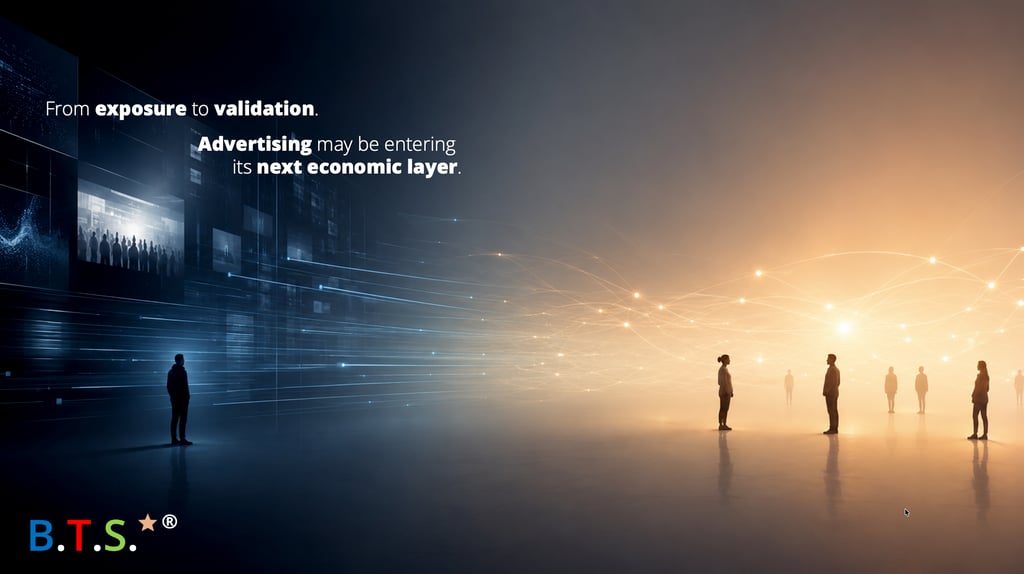
For decades, advertising has been built around a simple logic: reaching as many people as possible with a message. The greater a campaign’s reach, the more it was expected to influence behavior. But in an environment saturated with content, opinions, recommendations, and social cues, exposure alone is no longer enough to build conviction. Consumers no longer ask themselves simply, “Have I seen this ad?” but rather, “Do others confirm it?” Gradually, advertising seems to be shifting from an economy of impressions to an economy of validation. And this transformation could profoundly redefine how media creates value.
Stéphane LE BRETON
5/11/20264 min read

Advertising has historically been built on exposure
For decades, advertising has been based on a relatively stable formula: a message, a medium, an audience.
The brands’ mission was to craft a message that would stand out. The media’s mission was to give it as much visibility as possible. The more a message was exposed, the more it was expected to influence behavior.
This logic has shaped the entire modern advertising industry. Television built its power on mass reach. Print media relied on repetition and editorial context. Digital media, for its part, has industrialized this logic through data.
Impressions, CPM, GRP, reach, frequency, attribution: the entire industry has gradually come to revolve around the ability to measure exposure and optimize performance.
The rise of digital platforms has further accelerated this trend. Google, Meta, and Amazon have brought unprecedented sophistication to measuring user response: clicks, conversions, ROAS, real-time optimization, behavioral targeting, and retargeting. Advertising has become an extremely effective system for generating measurable actions. And we must be clear: this model works. The financial performance of the major platforms demonstrates just how powerful these advertising infrastructures are.
But this efficiency has gradually shifted the industry’s center of gravity.
An increasing share of media spending has shifted toward environments capable of demonstrating immediate, attributable results. At the same time, media historically positioned at the top of the funnel—television, print, radio, and premium media—have seen their business models weakened. The question was no longer simply, “Which medium builds the brand?” but rather, “Which environment generates measurable action the fastest?”
This shift has profoundly altered the balance of the advertising market. But it has also created a reliance on what is measurable. Yet measuring a reaction does not necessarily mean measuring a conviction.
A click may indicate interest, but not necessarily a sign of trust. And that is probably where the limitations of the traditional exposure model begin today.
Validation is gradually becoming the new layer of trust
Perhaps the most significant change isn't technological. It's behavioral.
For a long time, brands controlled most of the advertising narrative. Advertising flowed vertically down to the consumer: a message crafted by the brand, broadcast by a media outlet, and received by an audience.
Today, this approach alone is no longer enough. Before making a purchase, consumers do their research: they read reviews, check ratings, watch how-to videos, browse comments, and see how other consumers have reacted.
In other words, they seek a form of collective validation before making a decision; this approach has become standard practice in many industries, including automotive, travel, retail, telecommunications, banking, insurance, consumer electronics, and hospitality…
Visibility continues to attract attention, but validation provides reassurance.
And in an environment saturated with commercial messages, this reassurance becomes crucial. This is probably one of the great paradoxes of today’s advertising industry: brands have never had greater capacity to spread their messages… but they no longer have complete control over the mechanisms of credibility.
Trust is now built in a much more horizontal way. This shift partly explains why community platforms, content creators, customer review systems, and participatory models are becoming so important.
Audiences no longer want to simply receive messages; they want to see if those messages are corroborated by others. And this shift could gradually transform the very role of the media.
Because tomorrow, the value of a media environment may no longer depend solely on its ability to generate reach, but also on its ability to link exposure to a form of credible validation.
Advertising isn't going away, but it may be entering a new phase: one in which mere exposure is no longer always enough to persuade people.
From the economy of printing to the economy of evidence
This transformation is still gradual, but its effects are becoming visible throughout the advertising ecosystem. For years, media value was primarily based on a quantitative approach: more impressions, more reach, more frequency. Exposure was the primary unit of value.
However, this equation becomes less clear-cut in an environment where attention is fragmented and skepticism toward commercial messages is on the rise. A visible advertisement is not necessarily a credible one. And above all, an advertisement that performs well in the short term does not always guarantee a lasting relationship with the consumer.
This is where a new layer of value gradually emerges: proof. Not proof in the legal or rational sense of the term, but behavioral and social proof: real-life experiences, consumer endorsements, and visible signs of trust.
This shift does not mean the end of mass media. On the contrary, premium media retain a significant advantage: their ability to capture attention on a large scale, quickly and emotionally.
But this attention alone is no longer always enough to reduce uncertainty. And in many areas, it is precisely this reduction in uncertainty that now determines the decision.
That is why these concepts are gradually beginning to move into the very heart of media platforms:
social proof,
validation,
engagement,
consumer reviews,
perceived credibility,
This shift is significant because, historically, validation took place after the product was released: on Google, review platforms, YouTube, Reddit, forums, or marketplaces.
In the future, it could be directly integrated into the advertising experience itself. In other words, the medium would no longer serve merely to display a message; it would also begin to facilitate its validation.
This is likely where a more profound shift in the market is taking shape: the gradual transition from a print-based economy to an evidence-based economy.
In this model, attention remains essential. But it is no longer enough on its own. The focus is shifting toward environments capable of reconnecting:
exposition,
credibility,
and validation.
Conclusion
Advertising is unlikely to abandon the performance-driven approach. And the media will not stop seeking reach.
But something is changing in the way value is created. For decades, exposure was more than enough to build influence. The media broadcasted, the audience received, and repetition gradually helped establish a brand in the consumer’s mind.
Today, this dynamic is becoming more fragile. Not because the media have lost their influence, but because consumers have become better equipped to verify information: they no longer simply accept a message at face value; they seek to confirm it.
This is probably one of the major, yet often overlooked, shifts in the contemporary advertising industry: credibility no longer stems solely from reach, but from validation.
In this context, environments capable of linking attention and evidence could become the most effective ones of the future.
So perhaps the question is no longer simply, “How many people saw the ad?” but is gradually becoming, “How many found the message credible?”
Exposure will remain a necessary condition, but validation could become the new measure of trust.
And perhaps, eventually, the new unit of value.
Our commitment
Reviving trust in brand advertising through innovation.
CONTACt
info@buytryshare.com
+33 6 83 53 70 41
© 2025. SLB consulting. All rights reserved.