




When streaming reshapes the advertising ecosystem and challenges trust
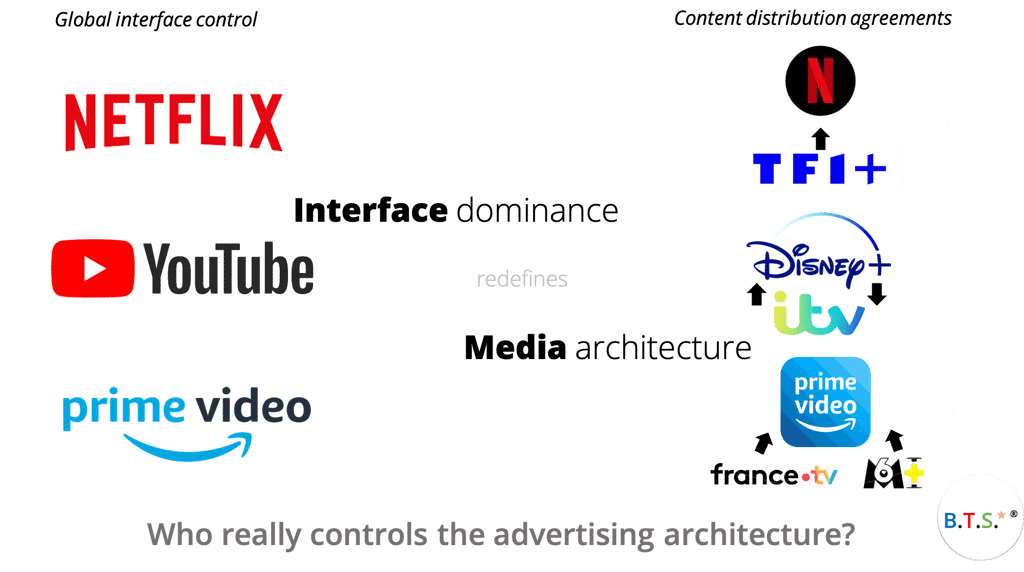
Advertising investments are gradually shifting away from traditional media towards digital and streaming environments. Netflix is establishing itself as a major advertising player and aims to capture nearly 10% of global CTV advertising spend by 2027, while distribution agreements such as M6+ within Prime Video (joining France.tv) are redefining how audiences access content. Interfaces are becoming universal gateways. What we are seeing is not simply a budget migration. It is a reconfiguration of the advertising trust framework, a transformation of the architecture of advertising trust.
Stéphane LE BRETON
2/22/20265 min read
Streaming, CTV and advertising: towards a new investment landscape
For several years now, advertising investment has been gradually shifting away from traditional media towards digital, connected and interactive environments.
More recently, this dynamic has taken on a new dimension:
Netflix is now on track to capture a significant share of global CTV advertising investment, soon to account for nearly 10% of total CTV advertising spend — a strong sign of the advertising market's reshaping. (source: The Media Leader)
In France, Prime Video has integrated M6+ into its interface, giving millions of Prime subscribers access to the group's channels (M6, W9, 6ter, Gulli) at no extra cost — an illustration of the direct convergence between global platforms and local inventories. (source: Ideal-Investisseur)
At the same time, advertising revenue generated by podcasts and native video formats continues to show double-digit growth, highlighting the growing importance of these formats in capturing audience attention. (source: The Media Leader)
These developments signal a fundamental shift: the advertising landscape is being reshaped around powerful, multi-screen platforms, where the concept of media framework — and therefore trust — is undergoing radical change.
When streaming becomes an inventory... but also an environment
Streaming platforms are no longer just content distributors. They have become:
a content distribution tool with advertising inventories,
an advertising exhibition space with attention interfaces
an attention-capturing interface based on broadcasting architectures.
What was previously fragmented (TV channels, local streaming services, on-demand content) is now tending to be grouped together under a single ‘portal’.
In a traditional linear environment, the framework was clear: editorial responsibility was identified, content hierarchy was structured, and context was controlled.
In a platform environment:
content is aggregated,
distribution is algorithmic,
the interface becomes the framework.
The strategic question is no longer simply: Where can I effectively reach my audience? But in what environment does my brand truly build credibility?
BVoD: digital power, editorial architecture
Beyond global platforms such as Netflix and Prime Video, the BVoD platforms of traditional channels are also experiencing significant and structured audience growth.
TV channels' BVoD platforms thus take on a special dimension. Unlike purely algorithmic environments, they rely on :
Identified media brands,
Assumed editorial responsibility,
Continuity between linear and digital,
A consistent framework between content and advertising.
They combine:
the flexibility of streaming,
the power of CTV,
and the editorial architecture inherited from television
At a time when global platforms are capturing the interface, BVoDs are retaining the architecture. They are not simply monetised video streams. They extend a structured framework in the digital environment.
In France, video on demand (VoD) consumption — including channel offerings (BVoD) — now accounts for around one third of total video viewing time, with more than 6.5 million daily viewers watching this type of content in 2023, a sharp increase compared to five years earlier. This practice of ‘television on demand’ has become ingrained in the daily lives of audiences, with VoD viewing now accounting for 33% of total video consumption, rising steadily year on year.
In terms of advertising in Europe, premium BVoD content dominates streaming ad views, accounting for up to 76% of premium impressions on digital streaming environments in 2025, highlighting its appeal and engagement potential for advertisers
These uses show that while TV channels are gradually losing their linear audience, they are transforming and extending this audience in controlled digital environments, expanding opportunities for contact while offering brands more contextual advertising frameworks than simple anonymous programmatic broadcasting.
Trust becomes a strategic issue
It is no coincidence that the next edition of the UDECAM Meetings places trust at the heart of the debate: ‘The new drivers of trust.’
When media consulting and buying professionals make it a central issue, it means one thing is clear: the question now goes beyond performance. It touches on the very structure of media environments.
In a context where:
Budgets are shifting massively towards streaming,
platforms are focusing attention,
AI is making synthetic content indistinguishable,
interfaces are unifying heterogeneous editorial universes,
Trust is no longer an added bonus; it has become a strategic asset.
In this reconfigured landscape:
How can attention be measured in a way that is comparable to traditional environments?
How can a stable and identifiable advertising context be guaranteed?
How can proof and credibility be maintained for brands in inventories that automatically integrate third-party, dynamic and sometimes algorithmic content?
These issues go beyond mere performance optimisation to touch on a broader challenge: the ability of this new ecosystem to provide a reliable environment conducive to building trust.
A structural shift to be analysed
The divide between performance and trust, already highlighted in our previous editions, is growing stronger:
Platforms offer powerful performance: granular targeting, audience measurement, real-time optimisation.
Structured media offer an identifiable framework: editorial responsibility, content hierarchy, explicit moderation.
In an environment where AI enables the mass production of synthetic content, the line between what is “safe” and what is “trustworthy” becomes less clear.
What creates value is the quality of the environment in which advertising exists. The debate is no longer just about ‘Is my brand safe?’ but about ‘In what environment does my brand build lasting trust?’
This redefines two essential things:
Brand safety: no longer just protection against risky environments, but a proactive approach to selecting contexts.
Contextual trust: which depends not only on the message, but also on the media environment in the broadest sense.
The development of CTV platforms, catalogue aggregation and the rise of hybrid environments combining local and global content are profoundly transforming the way audiences consume media. But they are also transforming the nature of the advertising landscape.
In a conventional linear environment:
the editorial context is identified,
the content hierarchy is structured,
responsibility is embodied.
In a platform environment:
the content is aggregated,
the interface is unified,
distribution is algorithmic.
The question then becomes strategic: Is the platform simply an inventory or a fully-fledged editorial environment?
What this means for the ecosystem
In this reconfigured context, several questions deserve to be asked:
Do attention measurement models need to be reinvented to incorporate unified streaming environments
How can brands guarantee the credibility and transparency of their advertising beyond performance metrics alone?
Can media outlets fighting for survival take advantage of this redistribution of investment?
And above all: what place is there for context, proof and trust in advertising that is increasingly moving beyond traditional editorial environments?
The real challenge
Streaming is redrawing the investment map. Platforms are redefining access to content. Audiences are migrating to hybrid environments.
The challenge is no longer just about securing distribution. It is about choosing the right framework: because in a market dominated by attention, context becomes a strategic asset. And trust becomes a competitive advantage.
But one question remains: how can we rebuild trust in advertising in fragmented, algorithmic and sometimes opaque environments?
Part of the answer lies in returning to the evidence.
Authenticated reviews.
Real customer experiences.
Structured post-purchase conversations.
When advertising goes beyond simply spreading a message and relies on tangible evidence, it not only gains credibility, it also gains :
trust,
attention,
commitment,
and economic value.
In a changing ecosystem, the media framework is essential. But when enriched with evidence, this framework becomes a multiplier of trust.
In an ecosystem dominated by attention, context becomes a strategic asset. And proof becomes a confidence booster.
Our commitment
Reviving trust in brand advertising through innovation.
CONTACt
info@buytryshare.com
+33 6 83 53 70 41
© 2025. SLB consulting. All rights reserved.