




The sharing economy is making headlines
For decades, the media have been conceived as broadcast environments: content is produced, distributed, and consumed. But this paradigm is shifting. Moving from passive consumption to active participation, audiences are no longer content to simply watch; they comment, evaluate, share, and influence. Participation is no longer a marginal phenomenon; it is becoming a new, fundamental component of media value.
Stéphane LE BRETON
5/5/20267 min read

The end of the passive hearing
For decades, the media model has been based on a simple assumption: the audience is watching.
It is exposed to a message, picks up information, possibly constructs a perception. The value of the medium is then measured by its ability to organize this exhibition — touch, repeat, memorize. It is this logic that has structured the entire media economy, from television to digital platforms: more reach, more frequency, more efficiency.
This model is not wrong. It has even been extraordinarily successful. Television has industrialized attention, digital has amplified it, data has optimized it. But it is based on a fundamentally unidirectional vision: the media speaks, the audience listens.
It is precisely this vision that is cracking.
Because what has changed is not just technology, but behavior. The audience is no longer content to consume. It reacts, expresses itself, compares, influences. It no longer simply looks at a message: it puts it in perspective, validates it, disputes it, prolongs it.
What used to be marginal practices has become a standard. Today, almost all consumers consult reviews before buying. Decisions are no longer built solely on what brands say, but on what other consumers say. In other words, perception is no longer only played out in the exhibition, but in the interaction.
This is where the lag appears. Media models continue to measure attention, visibility, exposure. They quantify what is seen. But they still very imperfectly capture what is believed. But in a message-saturated environment, the difference is no longer only in the ability to emerge, but in the ability to convince.
This shift is profound, because it transforms the very nature of the audience. It is no longer just a target to be reached, but an active component of the system. It produces signal, it influences perception, it participates in the construction of credibility.
In this context, simply being seen is no longer enough. Simply being heard is no longer enough. Even simply being understood is no longer enough. What matters most is whether—or not—a message is validated by others
This is where the limitations of the traditional model become apparent. As long as the media outlet limits itself to broadcasting, it captures only part of the value. It commands attention, but not what actually follows. Yet it is precisely in this “post-exposure” phase that what really matters now takes place: the formation of conviction.
And it is this shift—which is still largely underestimated—that paves the way for a broader transformation of the media’s role.
Participation as a new infrastructure
If the audience is no longer passive, then the issue is no longer just one of exposure, but of what is happening around it. For the transformation underway is not limited to a shift in behavior; it is fundamentally redefining the way value is created within the media ecosystem.
For a long time, this value was based on a simple sequence: produce content, distribute it, and attract an audience. The media was, above all, a vehicle. Its power was measured by its ability to bring a message and an audience together.
But this model is being superseded by a more complex one, in which value no longer comes solely from the content itself, but from the interactions it generates.
In other words, content alone is no longer enough. What matters is what’s built around it. This is precisely what platforms understood before anyone else:
Amazon isn't just an e-commerce site; it's a continuous rating system.
Google doesn't just index information; it assesses its credibility using various signals.
Social media, for its part, does not merely disseminate content; it ranks its impact based on the reactions it elicits.
In all these cases, engagement is not just a “bonus.” It is at the heart of the model; it shapes visibility, feeds algorithms, and influences decision-making. It transforms static content into a dynamic signal. And above all, it creates something that distribution alone cannot produce: perceived credibility. This point is essential.
Because in an information-saturated environment, where every message is potentially open to question, credibility can no longer be imposed. It is built collectively. It emerges from a combination of subtle cues, interactions, opinions, and cross-validations.
This is what McKinsey’s work on the “Consumer Decision Journey” has shown for several years: an increasing proportion of purchasing decisions are made outside the touchpoints controlled by brands. They are shaped in spaces of exchange, recommendation, and diffuse influence.
This shift has a direct consequence: participation becomes an infrastructure. Not merely a format or one engagement mechanism among many, but a fundamental component of the system. It governs the flow of information, determines its credibility, and ultimately, its effectiveness. It is precisely here that a new asymmetry emerges.
On the one hand, platforms have embraced this approach and scaled it up: they capture, organize, and monetize user engagement. On the other hand, premium media outlets continue, for the most part, to operate on a broadcast model.
Yet they possess a considerable asset: a direct relationship with their audiences, editorial legitimacy, and a more quality-oriented consumption environment. But this asset remains underutilized as long as it is not linked to participatory mechanisms.
For without participation, an essential dimension is missing: the ability to turn attention into conviction. What is at stake here is not a minor evolution of the media model. It is a paradigm shift.
Media is no longer just a space where people view a message. It is becoming a space where that message is discussed, validated, reinforced—or undermined. And it is in this ability to shape participation that value is gradually shifting.
The Paradox of Premium Media
If participation becomes infrastructure, then a question arises: where does value lie in today’s media ecosystem?
The contrast is striking. On the one hand, platforms have built models in which user engagement is central; they capture interactions, structure them, and leverage them. It is these signals that feed their algorithms, rank content, and ultimately influence decisions.
On the other hand, premium media outlets continue, for the most part, to operate on a broadcast model; yet they possess considerable strengths: an engaged audience, a direct relationship with their readers, and editorial credibility built up over time. All of these factors should, in theory, place them at the heart of this trust-based economy. But in reality, they are losing out on some of that value.
Because these media capture attention… without always structuring what follows. Interaction exists, but it often remains peripheral; it is neither organized nor integrated into the core of the media ecosystem. This is where the paradox lies: premium media are environments of trust, yet they do not fully activate the mechanisms that generate that trust on a large scale.
At the same time, platforms—which are less credible from an editorial standpoint—are capturing an increasing share of the value… precisely because they have built participation into their architecture. This disconnect points to a more profound shift.
Value no longer lies solely in the ability to convey a message, but in the ability to generate and organize the interactions that result from it. In other words, attention alone is no longer enough: it must be complemented by engagement.
Because it is through this engagement that perception is now shaped. It is no longer just the message that matters, but what is said around it. It is no longer just the brands that speak; it is the audiences who validate, qualify, or challenge.
And it is precisely this dynamic that current models still do not fully capture.
Audience engagement as a driver of performance
This shift toward engagement is not merely a cultural trend; it has direct implications for performance. For several years now, studies have consistently pointed to one thing: trust is a key determinant of marketing effectiveness.
Nielsen’s research shows that peer recommendations remain among the most credible sources. Kantar’s analyses highlight that a brand’s perceived differentiation relies largely on its ability to be trusted. Other studies, particularly in the areas of customer reviews and user-generated content, confirm that these signals directly influence purchasing decisions.
And yet, these factors still fall largely outside the scope of traditional performance metrics. We optimize visibility, acquisition costs, and conversion rates. But we still struggle to measure what drives the decision in the first place: credibility. That is where the gap lies.
Consumer engagement already exists. Consumers comment, rate, and recommend. But these signals remain fragmented, scattered, and rarely integrated into the media platforms themselves.
They influence the decision… without being fully connected to performance. Yet it is precisely this connection that is becoming strategic. Because in an environment where attention is abundant and competition is fierce, the difference no longer lies solely in the ability to generate traffic or conversions. It lies in the ability to reduce uncertainty.
And this reduction in uncertainty comes through evidence: evidence of use, evidence of experience, and validation by others. In other words, through structured forms of participation.
What is emerging, therefore, is a logical evolution of the model. Attention remains essential, performance remains measurable, but engagement becomes the link between the two.
It transforms a message into a credible signal. It turns exposure into conviction. It enhances performance by giving it a stronger foundation. In this context, integrating participation into the core of media strategies is no longer an option but a structural shift.
Audience participation is not a trend but a structural transformation
Consumers are already interacting, commenting, and reviewing: platforms have built their business models around this reality. Premium media outlets now have the assets to capitalize on it. What’s still missing is integration.
For as long as participation remains peripheral, it influences decision-making without being fully linked to performance. Yet it is precisely this link that becomes strategic.
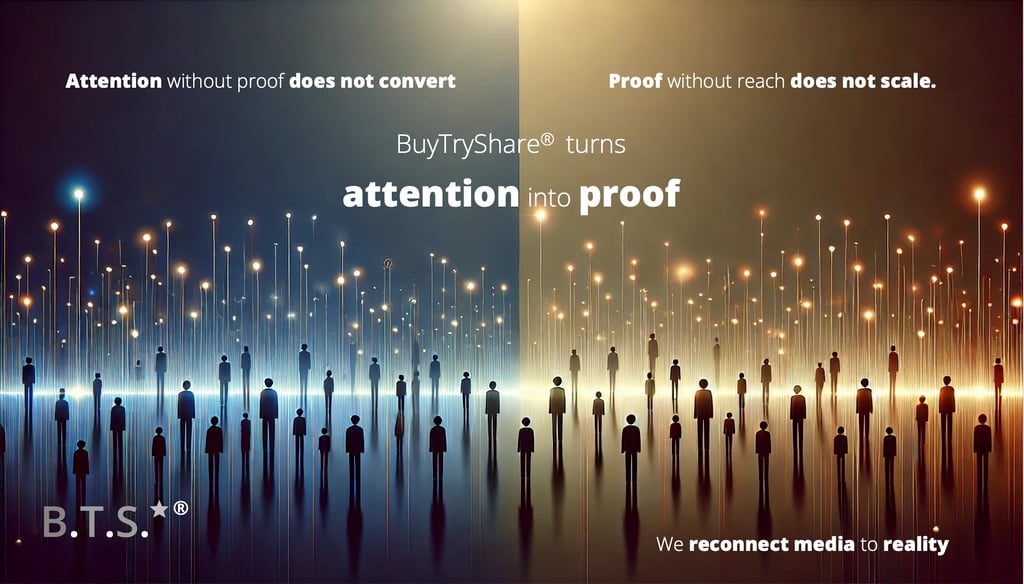
In a saturated environment, performance no longer depends solely on the ability to convey a message. It depends on the ability to reduce uncertainty, and that reduction comes through proof.
With this in mind, we at BuyTryShare have begun exploring what a performance enriched by trust might look like.
Rather than through rhetoric, the Proof ROI Engine uses scenarios to estimate—across different contexts and industries—the potential impact of integrating a layer of proof—derived from actual consumer engagement—into a media campaign. The goal is not to prove but to test a hypothesis: what happens when attention meets proof?
The initial findings are clear: participation, when structured and actively engaged, does not replace performance; rather, it changes its nature. It transforms an exhibition into a signal, an intention into a conviction, and a measured performance into a credible one.
What the media reports generates attention; what audiences express builds trust. The next step is to connect the two.
Engagement with the media is therefore not an option. It is a logical next step and, most likely, the next phase of the model.
Our commitment
Reviving trust in brand advertising through innovation.
CONTACt
info@buytryshare.com
+33 6 83 53 70 41
© 2025. SLB consulting. All rights reserved.