



The rise of evidence-based advertising
In recent years, brands have all been looking for the same thing: proof (social proof, UGC, customer testimonials, etc.). Marketing departments want to show real experiences, agencies include consumer reviews in their recommendations, the media talk about authenticity. But one question remains largely under-explored: what distinguishes a marketing proof… from a credible proof? Because as UGC content multiplies, a new challenge appears: trust no longer depends only on the existence of a testimonial, but on its demonstrable credibility. In other words, we may be entering a new phase of advertising: the era of evidence-based advertising. An ad where performance is no longer based solely on creation, targeting or repetition, but also on the ability to integrate credible customer proof into the media ecosystem. Indeed, behind the trust issue may lie a deeper transformation: the shift from advertising based on promise to advertising based on evidence.
Stéphane LE BRETON
4/4/20266 min read
Why brands are looking for evidence everywhere
If brands today are looking so much to integrate evidence into their marketing devices, it is not by fashion effect. This is because consumer behavior has changed profoundly.
For a long time, advertising operated according to a relatively simple logic: exposure, memorization, preference. Today, an additional step has taken place between exposure and decision: verification.
Before buying, consumers are now looking to confirm what advertising promises. They consult:
customer reviews
product notes
comparisons
feedback
discussions between users
This reflex is no longer marginal, it becomes structural. It's all about trust.
According to BrightLocal, 49% of consumers say they trust online reviews as much as personal recommendations. Nielsen, for its part, had already pointed out that recommendations from well-known people are the most credible advertising format, and that consumer opinions published online are also among the most reliable formats.
This evolution can also be seen in research practices. According to Sprout Social, 37% of consumers first turn to social media to search for product reviews and recommendations, and 52% of social media users prefer social research to AI chatbots precisely to access UGC and lived experiences.
In other words, advertising does not disappear, but it often becomes the starting point of a validation process. Advertising triggers interest, evidence triggers trust.
From attention to reinsurance
This transformation is already reflected in trademark arbitrations.
In the food & beverage sector in Europe, the Kolsquare study published at the end of March 2026 shows that advertisers are stepping up their collaborations with creators, that 63% favor long-term partnerships, and that 51% rely on the production of user content (UGC), while a significant part also relies on paid amplification. The signal is clear: brands are no longer just looking for visibility, they are looking for formats that can reassure, give credibility and validate their promises. In 2025, Unilever announced that it wanted to devote up to 50% of its media investments to influence, creators and social ecosystems, illustrating a massive shift towards environments where customer proof and recommendation play a central role. This type of decision shows that the issue is no longer just attention, but the perceived credibility of advertising messages.
This logic goes far beyond Europe and the perimeter alone influences. The global influencer marketing platform market was estimated at $25.44 billion in 2024 and $34.25 billion in 2025, with an expected growth of 23.3% per year until 2030. In Europe, this market is also expected to grow strongly, with a CAGR of more than 22% according to Grand View Research.
These numbers don't just mean that influence is growing, they show something deeper: brands are shifting some of their advertising efficiency to environments where perceived evidence is already embedded.
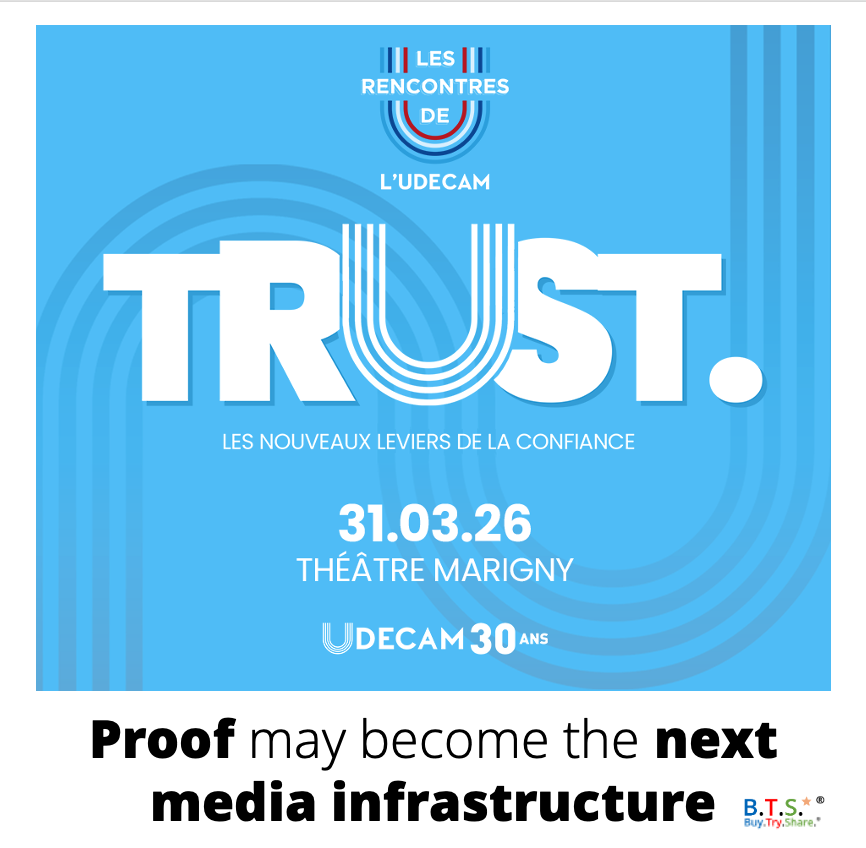
This shift towards trust is no longer just a marketing issue, it is becoming an industry issue. The fact that trust was at the heart of the 30th UDECAM Meetings in 2026 illustrates this development. The presence, for the first time in two years, of emerging initiatives such as BuyTryShare at this meeting confirms that the issue of proof and advertising credibility is now taking root in the market's structuring reflections. A cultural transformation rather than a technological one.
One would think that this evolution is primarily technological. In reality, it is mostly cultural.
Consumers no longer just want to hear what brands are saying about themselves, they want to know what other customers are saying. This shift in authority is fundamental.
Credibility is no longer based solely on:
the media power
creative quality
advertising rehearsal
It is also based on the perception of real, observable and shareable experiences. This is probably why brands are investing so much in:
the social proof
UGC
the testimonies
customer returns
But this mounting evidence creates a new problem. Because when everything becomes evidence, all evidence is no longer equal.
The emerging problem is that not all evidence is equal
If brands are now looking for more evidence, a paradox is beginning to appear. As evidence becomes ubiquitous, its value tends to diminish.
Like the attention yesterday, the evidence in turn enters a form of inflation. Consumers are now exposed to:
thousands of reviews
continuous UGC content
sponsored testimonies
recommendations from influencers
aggregate ratings
But this abundance raises a new question: what evidence is really credible?
Because the presence of a witness is no longer enough to create trust. What matters now is the perception of its authenticity.
The Age of Permanent Doubt
This development is part of a broader context of information mistrust. Consumers now know that:
some opinions are false
some testimonials are sponsored
certain UGC content is encouraged
most influencers are paid
According to several studies on digital trust, a majority of users now report spontaneously doubting the authenticity of the commercial content they encounter. In other words, evidence no longer automatically creates trust. It must now earn it.
From visible evidence to credible evidence
This is probably the most important change in progress: for a long time, the objective was to make the evidence visible; today, the challenge becomes to make the evidence credible.
This move is major because it changes the strategic question that was previously, how to show evidence? but now is: how to show that this evidence is reliable?
It is no longer just a marketing issue. It's a trusted infrastructure topic.
The risk of a new saturation
This inflation of evidence creates a risk similar to that which advertising has experienced with attention. When everything becomes proof: nothing really differentiates one proof from another.
An authentic opinion can be found alongside:
an incited opinion
a sponsored review
an unverified review
a manipulated opinion
For the consumer, the border becomes blurred and when the border becomes blurred, confidence decreases.
This is where perhaps the next stage of advertising is taking shape: the transition from an economy of proof to an economy of certified proof.
The next frontier: demonstrable credibility
If attention was the battle of the 2000s, and performance was the battle of the 2010s, the current decade may well become one of credibility.
Because in a saturated environment
visibility is no longer enough
proof is no longer enough
even declared authenticity is no longer enough
What becomes differentiating is the ability to demonstrate that the evidence itself is reliable. And it probably opens up a new category in the advertising ecosystem: that of devices capable of providing not only proof, but verifiable proof.
Towards a new layer of advertising: proof as infrastructure
If proof becomes a central issue, then a new question arises: where should it live in the advertising ecosystem?
Today, customer proof is essentially fragmented. It exists:
on review platforms
on social networks
in e-commerce environments
in CRM policies
in branded communities
But it rarely remains integrated in a structured way into the media environments themselves. But if credibility becomes a key factor in advertising effectiveness, evidence could gradually become a new layer of advertising, along with:
creation
targeting
dissemination
the measure
A layer dedicated to credibility.
From advertising creation to trusted architecture
This development could mark a significant shift in the role of the media. For a long time, their main function was to spread messages. Then it became: optimizing performance. It could now also become: ensuring environments of trust.
From this perspective, the question is no longer just: what message to spread? But also: what evidence can accompany this message to strengthen its credibility?
This shift is major because it transforms advertising from a simple exposure lever into a possible reinsurance lever.
Advertising as a trusted infrastructure
This transformation could also restore a strategic role for premium media environments.
In a context where platforms have captured engagement and social evidence, the media could regain some form of competitive advantage on another ground: trust.
Because historically, premium media didn't just sell audience. They also sold an editorial context, a credibility, a form of implicit validation.
If evidence becomes a structuring element of advertising effectiveness, these environments could become spaces capable of integrating not only attention, but also credibility.
In other words: after attention economics, and performance economics, we may be entering an economy of trust.
From promise to proof
This could mark an even deeper transition. For decades, advertising has operated on the promise: promise of quality, promise of efficiency, promise of difference.
But in a world where information is constantly circulating, the promise alone is gradually losing its strength. What becomes differentiating is no longer just what the brand says.
This is what the customer experience demonstrates. Advertising could thus evolve from a model centered on promise to one where evidence becomes a natural component of media efficiency.
The next competitive advantage could be credibility
If attention is still needed and performance remains essential, credibility may well become the next competitive advantage for brands.
Not as a supplement. But as a structuring element of advertising efficiency.
Because in an environment saturated with messages, content and declarative evidence, what could make the difference is no longer just the ability to be seen but the ability to be believed.
And that may be where the next transformation of advertising is taking shape: from advertising designed to capture attention to advertising that can earn trust.
Our commitment
Reviving trust in brand advertising through innovation.
CONTACt
info@buytryshare.com
+33 6 83 53 70 41
© 2025. SLB consulting. All rights reserved.