




The Hidden Weakness of Performance Marketing
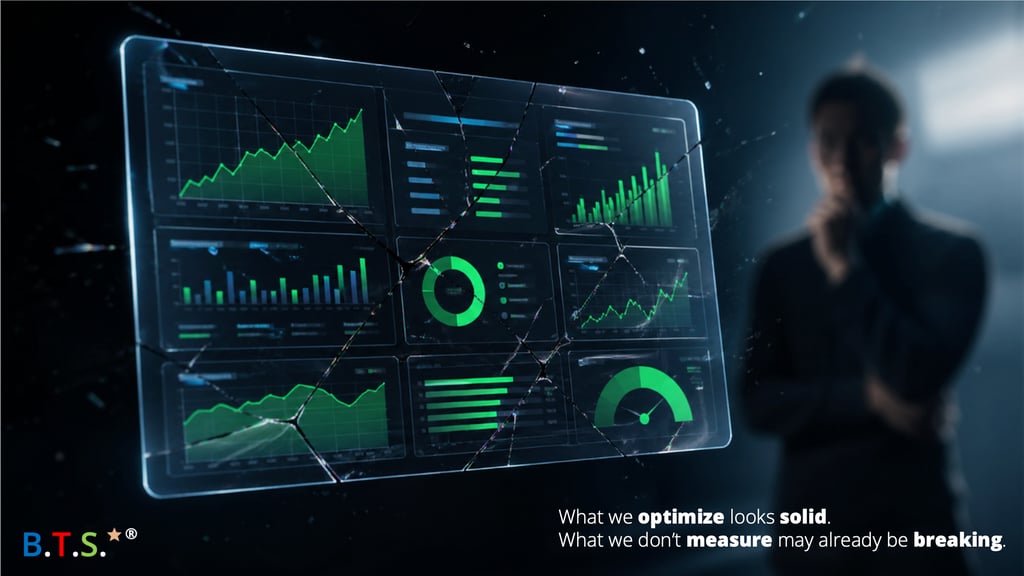
Performance marketing has never been more sophisticated. And yet, a structural weakness is emerging. By focusing on optimizing what is measurable—CPA, ROAS, conversion rates, and so on—we have built models that are extremely effective… but incomplete. Because in a saturated environment, performance no longer depends solely on the ability to drive action, but increasingly on the ability to be trusted. Here, we propose to put this limitation into perspective: not to call performance marketing into question, but to reveal its blind spot—and explore how proof and trust could redefine its boundaries.
Stéphane LE BRETON
4/27/20265 min read
When short-term optimization becomes a strategic blind spot
For years, digital marketing has had a clear goal: to make performance measurable, optimizable, and manageable—CPA, ROAS, conversion, attribution.
This promise has been largely driven by major technology platforms, which have built closed environments—often referred to as “walled gardens”—capable of capturing, organizing, and leveraging unprecedented volumes of data.
It is clear that this approach has yielded results: the financial performance of these companies speaks for itself, as does the widespread adoption of their solutions by advertisers.
But this effectiveness is limited to a very specific area: the ability to generate and optimize conversions. It has never come with the same promise in another, more complex realm: that of trust.
The limitations of these environments—whether in terms of inventory transparency, audience quality, or data governance—have been regularly highlighted in recent years.
In this context, a gradual shift has taken place. Attracted by the precision and measurability of the bottom of the funnel, most advertisers have been redirecting an increasing portion of their budgets toward these platforms, at the expense of media that have traditionally been positioned at the top of the funnel.
This shift has profoundly altered the balance of the media ecosystem.
First, from an economic perspective. Traditional business models—particularly those of the print media—have been weakened, with advertising revenues declining by as much as 50% to 70% over the past decade, depending on the market.
At the same time, the keys to success have become concentrated in the hands of a limited number of players.
But the issue goes far beyond the mere question of how investments are distributed. A structural dependency has taken hold. Today, major platforms are redefining the rules of the game through their financial and technological power. Certain developments are telling: Amazon founder Jeff Bezos’s purchase of The Washington Post and Elon Musk’s acquisition of Twitter illustrate their ability to intervene directly in the media landscape.
However, dominance does not rest solely on ownership. Platforms do not need to own the media to shape their economy: they already largely control its distribution, monetization, and data. This asymmetry is key.
An increasing portion of marketing performance now depends on environments whose rules are largely beyond the control of both advertisers and publishers.
And its implications go beyond marketing; this transformation raises broader questions about the quality of information, the structure of public debate, and, more broadly, the functioning of democracy, as the Fondation Jean-Jaurès points out.
This raises the question:
If conversion rates can be optimized with great efficiency,
at what cost is this performance achieved… and what is it actually based on?
This movement has profoundly transformed the industry. It has brought greater rigor, accountability, and an unprecedented capacity for optimization.
But in this quest for precision, a more subtle shift has taken hold—one that more and more stakeholders are beginning to recognize: not everything that is measurable necessarily creates the most value.
And above all: not everything that creates value is always measured.
An optimization machine… getting shorter and shorter
Performance marketing excels in one area: driving immediate results. Clicks, leads, conversions, sales.
But the more we refine these models, the more we observe a phenomenon well documented by the work of Les Binet and Peter Field (IPA): an excessive focus on the short term undermines long-term performance.
Their analysis of several hundred campaigns shows that:
Strategies that are overly focused on activation lose their overall effectiveness,
brand building remains a key driver of growth,
and striking the right balance between long-term and short-term goals is crucial.
This finding is supported by Nielsen studies: the formats that are most effective in the long term are not always the ones that perform best in terms of immediate attribution.
In other words: what we optimize today may limit what we build for tomorrow.
The blind spot: Trust isn't found in dashboards
That’s the crux of the matter. Performance marketing measures perfectly:
exposure,
interaction,
conversion.
Mais il mesure beaucoup moins bien :
perceived credibility,
trust,
conviction.
Yet these factors have become central. According to the Edelman Trust Barometer, trust in traditional advertising remains limited, and the credibility of messages increasingly depends on external evidence (peers, reviews, real-life experiences).
For its part, Kantar shows that creativity alone is no longer enough, and that a brand’s “meaningful difference” depends largely on its ability to be believed.
The problem is that these confidence signals are very rarely incorporated into performance models.
We optimize clicks, not beliefs. Performance marketing optimizes responses, but not necessarily conviction.
A growing—and fragile—dependence
Cette limite devient critique dans un environnement où :
acquisition costs are rising,
audiences are saturated,
and platforms that centralize measurement and distribution (and the majority of advertising investment)
Recent regulatory scrutiny of Google and Meta—particularly regarding market practices and transparency—highlights a growing tension: performance models rely on environments where the rules have changed and where clients (advertisers and their agencies) are no longer king. The balance of power has shifted.
At the same time, some platforms themselves acknowledge structural limitations:
proportion of fake accounts,
difficulties in independent measurement,
opacity of inventories.
This raises a simple question: Can we sustainably optimize performance when part of its foundation remains uncertain?
Customer evidence: a lever that remains underutilized
At the same time, another trend has emerged. Everyone can see how rapidly its importance has grown:
user-generated content,
customer reviews,
creators,
social recommendations.
According to several industry studies (Custplace, Bazaarvoice), more than 90% of consumers read reviews before making a purchase in certain product categories.
But this evidence is largely limited to:
e-commerce,
product pages,
bottom-of-the-funnel digital environments.
They are not fully integrated into the media’s own frameworks. As a result, there remains a disconnect between the production of evidence and its use in communication.
What the simulations reveal: toward improved performance
This is precisely the gap we set out to explore at BuyTryShare. Not through rhetoric, but through a model. The Proof ROI Engine (currently in beta) was built to answer a simple question: what happens when you incorporate customer proof into a media campaign?
We have modelled several verticals:
Automotive
Telecom
Bank / Insurance
Retail
Tourism
FMCG
Using various scenarios (base, upside, stress). The initial findings are clear:
customer proof does not replace marketing performance,
but it profoundly changes its dynamics
On observe notamment :
increased engagement,
an impact on indirect conversion,
greater overall effectiveness of the media mix.
In other words: proof acts as a booster of credibility… and therefore of performance.
The point, then, is not to pit performance against trust, but to reconcile the two.
The emerging model is more nuanced: reach -> proof (real-world experience) -> credibility (perception) => sustainable performance
In this context, the key question has shifted. Yesterday: How many people saw this message? Today: How many people believed it?
Conclusion: The limit isn't performance... it's its scope
Performance marketing has never been more powerful. But it has never been more incomplete.
Because it perfectly optimizes what it measures, but doesn't always measure what matters most.
Conversion rates can be improved. Trust must be built.
And in an environment saturated with messages, competitive advantage no longer lies solely in the ability to capture attention, but in the ability to reduce uncertainty.
Performance works without trust. Until it doesn't.
The next step won’t replace performance marketing. It will enhance it and redefine what “performing” really means.
Our commitment
Reviving trust in brand advertising through innovation.
CONTACt
info@buytryshare.com
+33 6 83 53 70 41
© 2025. SLB consulting. All rights reserved.