




Premium media: the next trusted platforms
For decades, premium media have been valued for their ability to capture attention and provide high-quality environments for brands. Television, print media, major publishing platforms: their role was clear—to deliver messages with impact and credibility. But in an environment saturated with messages, this approach has reached its limits. Today, the question is no longer just how many people see an ad, but under what conditions it is received… and believed. Because trust cannot be imposed. It is built, contextualized, and increasingly depends on the framework in which messages are presented. In this context, a major shift may be underway: what if premium media outlets no longer simply sold reach, but became true platforms of trust?
Stéphane LE BRETON
4/20/20268 min read
Advertising trust is not evenly distributed
For a long time, advertising was viewed as a relatively simple process: presenting a message to a specific audience, with enough repetition to create brand recall and, ultimately, drive action.
In this context, all the print campaigns were, if not identical, at least comparable. The challenge was to optimize their cost, targeting, and frequency.
It is clear that this view no longer holds true: in an environment where messages are everywhere, not all forms of exposure carry the same weight.
An advertisement viewed in a crowded social feed, amid sponsored content and algorithmic recommendations, does not have the same impact as a message presented in a controlled editorial environment. Similarly, a recommendation from a committed creator does not carry the same credibility as a message perceived as purely promotional.
In other words, advertising performance no longer depends solely on visibility. It increasingly depends on the conditions under which the ad is viewed. This trend has been widely documented.
Kantar's research on advertising trust shows, for example, that media environments directly influence how messages are perceived and their perceived credibility. Meanwhile, several studies cited by IAB Europe highlight that brand safety and context quality are no longer merely matters of protection, but are becoming drivers of effectiveness.
More broadly speaking, the Reuters Institute reports also highlight that trust in the media varies significantly across platforms, formats, and environments, which has a direct impact on how content—including advertising—is received.
These signals all point to the same conclusion: trust is not uniform across the media ecosystem. And this imbalance is no longer just a hunch. It is also evident in the way certain major platforms themselves acknowledge the limitations of their environments.
Meta states in its SEC filings that its estimates of duplicate, fake, or “violating” accounts are based on internal reviews of limited samples and involve a significant degree of judgment; for the fourth quarter of 2023, for example, the company estimated that duplicate accounts accounted for approximately 10% of its global monthly active users and fake accounts for approximately 4%.
In other words, some of the largest advertising environments on the market continue to be measured, valued, and billed even though their exact quality remains, at least in part, an estimate and is not fully understood. What few advertisers would have historically accepted in other media contexts has gradually become a tolerated norm in the platform economy.
The same unease is evident at Google. In April 2025, a U.S. federal judge ruled that Google had illegally maintained monopolies in two key segments of ad tech—publisher-side ad servers and ad exchanges—to the detriment of publishers, competitors, and, ultimately, the market. A few months later, the European Commission imposed a new antitrust fine on Google in the ad tech sector, accusing it of favoring its own services in the advertising chain.
These decisions do not merely point to abuses of dominant market power. They also highlight a deeper issue: part of the digital advertising ecosystem has developed within a framework where transparency, inventory control, and alignment of interests have not always lived up to the trust placed in it.
In this context, the question is no longer simply about where to broadcast. It also becomes: in what environments can a message still gain credibility rather than lose it?
This observation has several implications.
First, it challenges some of the purely quantitative approaches to optimization. Maximizing reach or frequency is no longer enough if reception conditions undermine the message’s credibility.
Next, it restores value to aspects that have long been considered secondary:
the editorial context
the consistency between content and advertising
the audience's perception of the media
the level of saturation in the media environment
Finally, it introduces a variable that is harder to grasp but essential: the recipient’s willingness to trust.
In this context, not all impressions are created equal. Some environments amplify messages. Others dilute them. Some lend them credibility. Others weaken them.
It is precisely in this gap that an increasing share of advertising performance is determined. If trust depends on the context in which a message is received, then the question is no longer just where to advertise, but in what context to make a message credible.
This paves the way for a more fundamental hypothesis: certain media environments may no longer be merely platforms for distribution, but could become trusted assets.
Why premium media outlets retain a structural advantage when it comes to trust
If trust is not evenly distributed across the media ecosystem, then the question arises: which platforms are currently best positioned to foster it?
Contrary to some common misconceptions, the answer does not lie solely in technology or in sophisticated targeting. It also lies in more fundamental—and sometimes underestimated—elements: the editorial context, the relationship with the audience, and the way a message fits into a given framework.
This is precisely where premium media—television, print media, and major publishing platforms—retain a structural advantage.
The significance of the context
Unlike fragmented and highly mediated environments, premium media operate within relatively controlled editorial frameworks.
Content isn't just distributed there; it is selected, prioritized, produced, or approved. This structuring creates an effect that is often invisible but decisive: it influences how advertising messages are perceived.
Several Kantar studies show that the quality of the media context has a direct impact on attention, recall, and brand perception. In environments deemed more credible, messages benefit from a halo effect that enhances their acceptability.
In other words, the medium does more than simply convey the message; it helps shape it.
A relationship built over time
The second major difference: the nature of the relationship with the audience.
While many digital environments rely on brief, often opportunistic interactions driven by algorithms, premium media are more focused on the long term.
Whether it’s television appearances, established media outlets, or well-known publishing platforms, they often benefit from a sense of ongoing engagement.
This continuity does not guarantee trust. But it creates a framework within which trust can be built.
Research by the Reuters Institute also shows that trust in the media varies significantly depending on the brand, format, and usage, but remains generally higher in environments perceived as editorially structured than in open, unmoderated feeds.
In this context, an advertisement does not exist in a neutral space. It is part of an already existing relationship.
Less opacity, greater clarity
Finally, premium media outlets generally provide a clearer framework in terms of distribution.
While some programmatic value chains remain complex, even opaque, with multiple intermediaries, premium environments often retain a more direct level of control over:
inventories
distribution contexts
and the overall coherence of the experience
That doesn't mean they're free of complexity. But it does reduce some of the uncertainty.
And in a market where transparency is becoming a key issue, this clarity directly contributes to the perception of reliability.
From environmental quality to reception quality
Historically, premium media have been valued for the quality of their user experience. But what is at stake today goes beyond that.
In a landscape where trust is becoming a key differentiator, their true advantage may lie in their ability to deliver high-quality reception, namely:
a setting where messages are less diluted
a context where they are more coherent
an environment where they can be better understood… and potentially better accepted
From premium media to trust platform: an evolution that is still incomplete
If premium media outlets have a structural advantage when it comes to trust, then one question becomes central: why does this advantage remain largely untapped in their monetization model?
Today, even in the highest-quality environments, advertising value is still primarily measured using metrics inherited from a different paradigm: impressions, reach, frequency, and CPM, supplemented by indicators of attention or visibility.
These indicators remain useful. However, they capture only part of the picture, as they measure the reach of a message, not its ability to be believed, accepted, or validated.
A value that is still difficult to define
That is where the crux of the problem lies. If trust becomes a driver of advertising effectiveness, then logically it should be:
measured
valued
and incorporated into economic models
However, it remains difficult to quantify today. Not because it doesn’t exist, but because it partly defies traditional metrics. Premium media outlets have a credible context, an established relationship, and the ability to drive action. But this combination is still rarely leveraged as a standalone economic asset.
It is used:
to justify a “quality-focused” positioning
to support pricing
or to reassure advertisers
But rarely to create a new layer of structured value.
Yet this is what the market is beginning to do elsewhere
Meanwhile, other parts of the ecosystem have already begun to monetize similar areas.
Retail media doesn’t just sell ad impressions: it monetizes a transactional relationship rooted in real-world usage.
Influence isn’t just about reach: it’s about the relationship between a creator and their community.
Some platforms are also seeking to build environments that foster engagement and recommendations.
In each of these cases, value doesn't come solely from volume; it comes from the quality of the connection.
Toward a new layer of monetization
It is precisely this approach that could be extended to premium media—not to replace their current business models, but to complement them.
Because if a media outlet is capable of:
capture attention
provide a credible context
build on a relationship with your audience
and use evidence or validation cues
So it’s no longer just selling bandwidth. It’s now able to enable a trusted infrastructure.
In other words, a platform where:
Messages are not only seen
but can be received in a context that reduces uncertainty
and enhances their credibility
A transformation that still needs to take shape
This trend is still in its early stages.
It is neither fully formalized, nor standardized, nor fully measured. But it is already implicit in advertisers’ expectations, in budget decisions, and in the way certain campaigns seek to incorporate more evidence, recommendations, or validation.
It is also for this reason that certain stakeholders are beginning to develop strategies aimed at making this aspect more transparent.
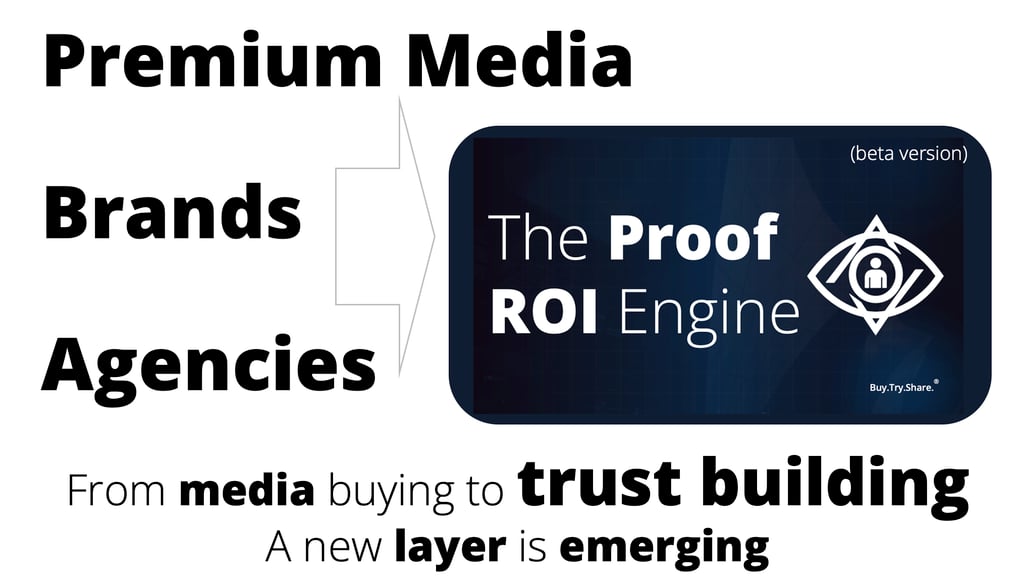
At BuyTryShare, for example, this approach led to the development of an ROI Simulator tailored to specific industries (automotive, banking/insurance, telecommunications, retail, tourism, FMCG)—not to reduce trust to a simple calculation, but to help advertisers translate that intuition into testable economic hypotheses.
The point is not to predict a specific outcome. It is to make tangible a dimension that is still too often perceived as intangible.
A new perspective on the role of the media
In this context, the role of premium media could evolve: they would no longer serve merely as platforms for optimized distribution. Instead, they would become environments capable of:
structure the way messages are received
enhance their credibility
and directly contribute to their effectiveness
No longer just “media channels,” but trust platforms
Conclusion
What this article highlights goes beyond a simple evolution in formats or channels. It is a more profound transformation of the very role of the media.
For decades, their value was built on their ability to capture and direct attention. Then that value shifted toward data, targeting, and optimization.
But in an environment where attention is abundant and trust is increasingly scarce, another shift is underway. Value no longer lies solely in reaching an audience, but in the ability to provide a context in which a message can be received, understood… and accepted.
Consequently, not all environments are created equal.
And certain media outlets—through their editorial structure, their relationship with their audiences, and their ability to exert control—could once again become key players in this new equation. Not simply because they are better at disseminating information, but because they can lend credibility.
If this hypothesis holds true, then a major shift is on the horizon. Premium media would no longer be valued solely for their ability to generate reach; they could instead be valued for their ability to reduce uncertainty surrounding messages. In other words, to transform exposure into credible reception.
In a market saturated with content, this ability could become a deciding factor. Because in the future, the question may no longer be, “How many people saw this message?” but rather, “In what context was this message credible enough to make a difference?”
And in this shift, a new understanding of the role of the media is emerging. No longer merely as channels, but as infrastructures of trust.
Our commitment
Reviving trust in brand advertising through innovation.
CONTACt
info@buytryshare.com
+33 6 83 53 70 41
© 2025. SLB consulting. All rights reserved.