



From content wars to interface control: how streaming is reshaping advertising architecture
846 / 5 000 We previously analyzed how the transformation of streaming is reshaping the advertising ecosystem and raising a central question: that of trust. But to understand this shift, we need to go back a step: to the architecture of the media themselves. Recent weeks have illustrated the audiovisual industry's entry into a new phase of transformation. Netflix ultimately abandoned its acquisition of Warner Bros. Discovery, with Paramount Skydance winning the bid with an offer of approximately $110 billion, creating a new global entertainment giant. But behind this financial drama lies a much more fundamental reality. Streaming is entering a phase of massive consolidation. And this consolidation raises a fundamental question: who truly controls the media architecture?
Stéphane LE BRETON
3/7/20266 min read
The new phase of the streaming wars
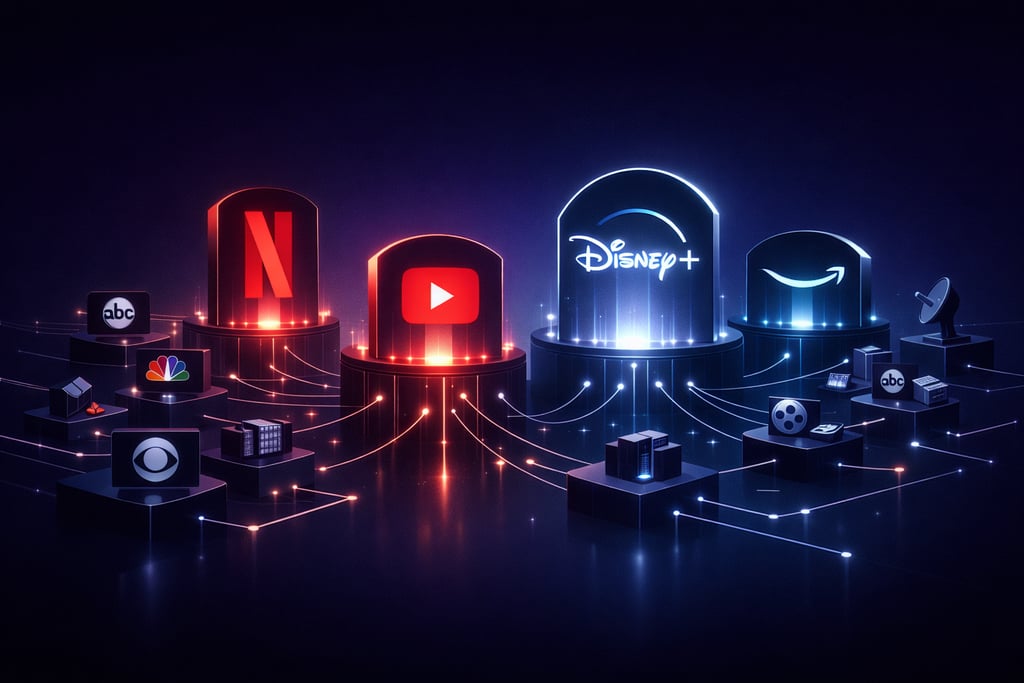
Each player launched its own platform. In 2007, ten years after its creation as a mail-order DVD rental service, Netflix made a strategic pivot: the company introduced its subscription-based streaming service. Subscription video on demand (SVoD) already existed in various forms, but Netflix was the first to make it a comprehensive industry model—thus ushering in a new era for the media economy. Once the market was validated, all the major media groups (Disney+, Paramount+, HBO Max) and tech companies (Prime Video) followed suit.
The battle was over :
content
subscribers
catalogues.
Each platform sought to attract viewers through its original productions and the breadth of its offerings. Success was measured primarily by the number of subscribers and the ability to produce exclusive content.
Today, a new phase begins. Platforms are no longer just looking to produce content. They are looking to structure access to content. Power is shifting.
Let's take some recent examples.
Netflix has entered into an agreement with TF1 to integrate the content of TF1+ into its platform. The goal is not simply to offer more programs. It's mostly about integrating this content into the Netflix interface, where users are already browsing. Content becomes accessible… but in an environment controlled by Netflix.
Amazon follows a similar logic. In France, Prime Video now offers direct access to M6+ and France.tv from its interface. The user stays in the Amazon ecosystem, even when watching programs from a traditional broadcaster.
The same movement can be found elsewhere in Europe. Partnerships between platforms and broadcasters are multiplying – whether it is distribution agreements, co-production or content circulation between digital environments (e.g. Disney+/iTV). Again, it's not just a question of the catalog, it's a question of the point of entry.
Dans tous ces cas, le contenu circule. Mais l’interface reste centrale. Autrement dit, la bataille ne porte plus seulement sur ce que l’on regarde, elle porte de plus en plus sur où et comment on y accède. Le groupe Canal+ l’a bien compris. Depuis plusieurs années, il développe une stratégie d’agrégation de plateformes — Netflix, Disney+, Paramount+ ou Apple TV+ — au sein de ses propres environnements. Avec myCanal en Europe et ses plateformes opérées via MultiChoice en Afrique, Canal+ ne se positionne plus seulement comme distributeur de contenus, mais comme interface d’accès aux contenus.
In all these cases, the content is circulated. But the interface remains central. In other words, the battle is no longer just about what you look at, it is increasingly about where and how you access it. The Canal+ group has understood this. For several years now, it has been developing a strategy for aggregating platforms — Netflix, Disney+, Paramount+ or Apple TV+ — within its own environments. With myCanal in Europe and its platforms operated via MultiChoice in Africa, Canal+ is no longer only positioned as a content distributor, but as an interface for accessing content.
Because in the economy of attention, the one who controls the interface controls:
navigation
the recommendation
the data
and, ultimately, advertising monetization.
The logic of streaming therefore evolves gradually: from content control to content access control. And this is precisely where the media architecture is being redrawn.
When broadcasters themselves become platforms
Faced with the rise of global interfaces, the historical broadcasters were quick to adapt their strategy.
Rather than remaining mere content providers for large platforms, they are now seeking to regain control of the relationship with the public. The answer lies in developing their own digital platforms. In Europe, this movement is particularly visible.
In France, TF1+, M6+ and France.tv embody this transformation. Audiovisual groups are no longer content with offering replay services: they are building real free streaming environments financed by advertising.
But this dynamic far exceeds the French market.
In the UK, ITVX has become one of the pillars of free streaming, combining on-demand content, FAST channels and original productions.
In Germany, RTL+ and Joyn — powered by ProSiebenSat.1 and Warner Bros Discovery — demonstrate the same drive to build platforms that can compete with global players..
In the Netherlands and Belgium, the DPG Media Group is also developing its own digital environments around its media and audiovisual brands.
In Italy and Spain, Mediaset (MFE) is pursuing a similar strategy with Mediaset Infinity, which brings together programs, streaming and advertising in the same ecosystem.
In all these cases, the objective goes far beyond the mere provision of replay programs. It is about building a complete editorial and technological environment:
a clean interface
a recommendation system
a direct relationship with users
and a controlled advertising framework.
In other words, broadcasters are looking to become architects of their media environments again.
This transformation is accompanied by a rapid growth in the audience of BVoD (Broadcaster Video On Demand) platforms.
In France, the platforms of audiovisual groups now gather tens of millions of users each month with several billion videos viewed per year.
In the UK, ITVX claims more than 30 million registered users, inherited from the old ITV Hub, and continues to increase its streaming volumes sharply.
In Germany, Joyn now exceeds 10 million monthly users, confirming the rise of free ad-supported platforms.
Also in Germany and Central Europe, RTL+ exceeds 7 million paid subscribers in its streaming services.
In Italy, Mediaset Infinity has established itself as the central digital platform of the Mediaset group, combining free streaming, replay and premium content.
These platforms now occupy a strategic position in the audiovisual ecosystem. They allow broadcasters to:
extend the life of their programs
reaching younger audiences
develop digital formats
and offer advertisers premium environments in a controlled environment.
In this context, BVoD is no longer simply a catch-up service. It becomes a real media architecture.
The rise of BVoD platforms reveals a paradox. Broadcasters have managed to rebuild a direct relationship with their audiences through streaming. Millions of users are now connected, identified and engaged in their digital environments.
But in today's advertising economy, these communities are still largely under-exploited. But behind these platforms is perhaps one of the most strategic assets of the media ecosystem: real consumer communities, capable not only of seeing advertising… but also of reacting to it, participating in it and reinforcing its credibility.
When trust becomes a media infrastructure
This is profoundly changing the dynamics of the market.
On the one hand, global platforms control powerful interfaces, capable of aggregating a wide variety of content.
On the one hand, global platforms control powerful interfaces, capable of aggregating a wide variety of content.
So the competition is no longer just about catalogs.
It now focuses on the ability to structure trusted environments.
It is precisely in this tension between global interfaces and editorial architectures that the advertising economy is redrawing itself.
Si les plateformes redéfinissent l’accès aux contenus, elles redéfinissent aussi la manière dont la publicité est perçue.
For a long time, the main issue for brands was visibility: reaching as many viewers as possible in the most powerful environments. But in a fragmented universe, dominated by algorithms and interfaces, another question becomes central: in what environment does a brand really build trust?
Advertising no longer evolves only in an inventory logic. It is part of editorial, technological and relational ecosystems. And in these ecosystems, trust becomes a key factor.
Global platforms have mastered certain levers: interface, recommendation, data and algorithmic optimization.
Traditional broadcasters, on the other hand, have another asset: the historical relationship with their audiences. With their BVoD platforms, they have managed to recreate a direct link with millions of connected users.
These hearings are no longer just viewers. These are:
identified users
committed spectators
but also real consumers.
And this is where a new opportunity for the advertising ecosystem appears. Behind these platforms lies a strategic asset that is still largely under-exploited: the ability to activate audiences themselves in the construction of advertising credibility.
From audience to community, a new frontier for advertising
For decades, television advertising operated according to a simple model: the media broadcast messages, audiences received them. But in a digital environment, this logic is evolving.
Platforms no longer only bring together passive audiences. They structure communities of connected users. Communities capable of:
to look
to react
to share
and potentially contribute to building trust around brands.
In a world where the content generated by artificial intelligence is multiplying and where the credibility of information is regularly questioned, this dimension becomes essential.
Advertising can no longer be based solely on the repetition of a message. It must be based on visible and credible signals of confidence.
Dans ce contexte, la question clé pour l’écosystème média n’est peut-être plus seulement : qui possède les contenus ? Ni même : qui contrôle l’interface ?
In this context, the key question for the media ecosystem may no longer be just: who owns the content? Or even: who controls the interface?
Because in the attention economy, credibility becomes a competitive advantage.
And the platforms that will succeed tomorrow will not be just those that distribute content or control interfaces. They will be the ones who will be able to structure environments where audiences, brands and the media participate together in the construction of this trust.
In the next phase of the media economy, value may no longer be played only in content or interfaces, but in the ability to organize trust between brands, media and audiences themselves.
Our commitment
Reviving trust in brand advertising through innovation.
CONTACt
info@buytryshare.com
+33 6 83 53 70 41
© 2025. SLB consulting. All rights reserved.