



Context, credibility, customer: the new golden triangle for brands in 2026
Trust is becoming the new hard currency of advertising. In a digital ocean saturated with dubious content, reach is no longer enough—legitimacy alone makes the difference. Discover how brands can be reborn by relying on trusted media (TV, press, cinema) and injecting the true voice of customers: certified, visible, and authentic post-purchase reviews. When proof becomes the lever, advertising regains its credibility.
Stéphane LE BRETON
12/6/20255 min read
The context is no longer neutral: it becomes a signal.
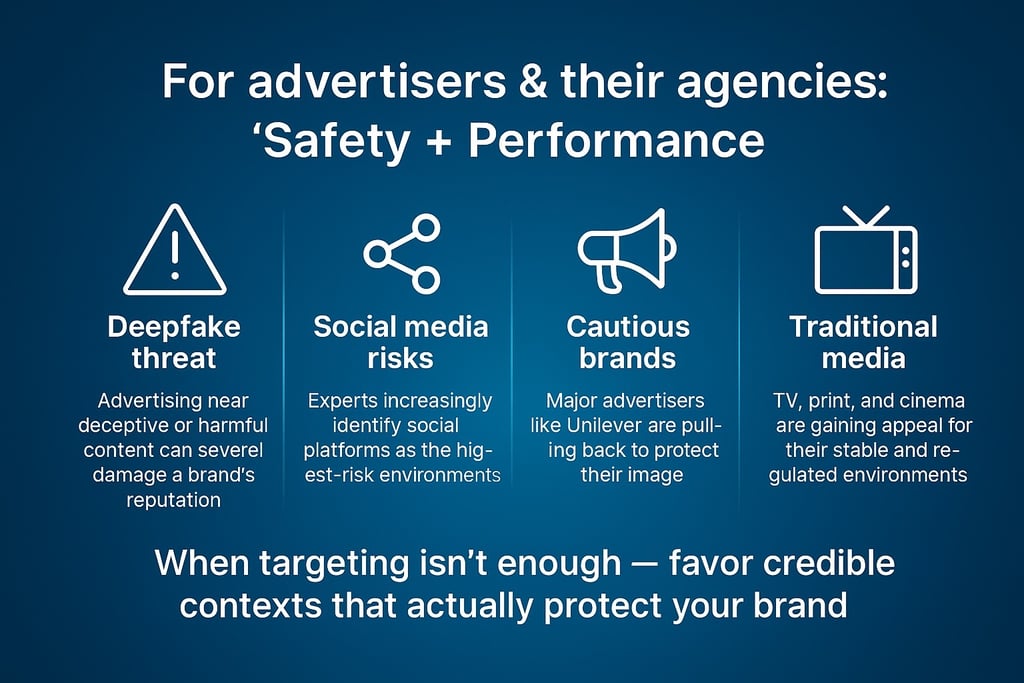
In 2026, the environment in which an advertisement is displayed no longer plays a mere background role. It actively influences how the message is perceived. Context becomes a co-brand symbol: it either lends credibility to or undermines what you have to say.
In other words: the channel stamps its reputation on your message.
👉 When an advertisement is broadcast on television, shown in movie theaters, or published in the pages of a well-known daily newspaper, it benefits from an aura effect. The host media acts as a quality filter: it reassures viewers, lends credibility to the brand's message, and increases the chances of engagement.
Conversely, distribution in a crowded social feed—between two pieces of UGC or alongside sensationalist videos—exposes the brand to dilution or even rejection. Even with relevant targeting, trust will not follow if the context does not support it.
This is a critical point in a market saturated with messages: it's no longer just what you say that matters—it's where you say it.
A visual broadcast on Canale 5 during the 8 p.m. news (TG5), a testimonial inserted in an insert in the New York Times, or a customer review shown before a movie in a UGC cinema, do not carry the same weight as a clip posted on Instagram or TikTok. The setting becomes implicit proof of reliability.
🎯 Conclusion: In 2026, brands must integrate a “context planning” approach in the same way as media planning or target planning. Because a good message in the wrong context becomes inaudible. Whereas a credible message in a respected context becomes proof.
A battle of confidence: traditional media outlets are holding out... but are in the crosshairs of GAFAM
In 2026, trust remains largely associated with regulated traditional media (television, press, cinema). According to the Kantar Media Reactions 2025 study, the media perceived as most trustworthy by consumers are still:
TV: 43% trust
Print media: 38%
Cinema: 35%
... compared to only 21% for social media and 19% for UGC video platforms such as YouTube or TikTok.
💡 However, these bastions of credibility are under pressure. The partial or targeted acquisition of "premium" media assets by streaming platforms or GAFAM companies is proof of this.
For example:
Netflix is in exclusive negotiations to acquire Warner Bros Discovery's “WBD Streaming & Studios” division in early 2027—including gems such as HBO, HBO Max, Warner Bros Pictures, New Line Cinema, TNT Sports, etc. This move would leave out linear channels such as CNN, Discovery, and Eurosport, which remain in the WBD Global Networks division. This type of split illustrates a dual phenomenon:
Platforms want to capture the aura of historical quality (HBO, cinema) to fuel their own offerings.
But they are leaving behind linear channels, which they consider less compatible with their model, even though they retain a strong foundation of trust.
Amazon's acquisition of MGM (finalized in 2022 for $8.45 billion) sends a strong signal: digital giants are not only investing in technology and targeting. They are seeking to acquire the cultural credibility and narrative power of the major traditional studios.
MGM has more than 4,000 films and 17,000 episodes of series—a global cultural footprint (James Bond, Rocky, etc.) that is far more powerful than any series native to a platform.
As The Guardian analyzed, Amazon did not simply buy a catalog, but “access to Hollywood's generational trust.”
➡️ This move confirms one thing: the perceived value of traditional media remains very strong—even among those who once disrupted it.
➡️ What this means for BuyTryShare: Even when under fire, traditional media remain a bastion of credibility. It is their association with certified customer reviews (post-purchase reviews, standardized boxes) that will enable them to reconcile media power with trust. And turn it into a strategic asset in the face of algorithmic invasion.
Context, credibility, customer: the new golden triangle for brands in 2026
For decades, brands occupied a central position in advertising narratives: they spoke, and the public listened (or not). But in 2026, this centrality shifted. It is no longer the brand's intention that convinces, but rather the customer's experience in a credible context.
Proof can no longer be decreed. It must be demonstrated.
A strong visual image, a reliable environment, an authentic voice: this is the new triptych of effectiveness. We no longer buy into promises. We adhere to proven results.
Customer testimonials move from reviews to advertising
Customer recommendations are no longer limited to product listings or Google reviews. They have become a strategic communication asset.
Concrete examples:
Automotive: a brand such as Audi could include a verified review from a recent buyer, certified according to ISO 20488, in its TV commercial.
Cosmetics: in a press insert, a post-purchase customer testimonial would reinforce the message of naturalness or dermatological tolerance of a L'Oréal Men Expert skincare product.
Food industry: a 7-second movie ad shown before a Cinemaxx screening, where a real certified customer would simply say “I didn't believe in plant-based yogurts... until I tried Alpro's".
In these three cases, advertising becomes shared evidence. And this evidence does not come from a slogan, but from real-life experience.
The brain encodes better when the source is perceived as reliable.
Neuroscience confirms this effect. According to a 2024 study by Neuro-Insight, an advertising message presented in a context deemed serious (reputable newspaper, news channel, movie theater) generates:
+23% activity in areas linked to long-term memory
+18% emotional resonance
A greater propensity to purchase if the source is perceived as “disinterested”
This means that the context influences not only how the message is received, but also how long it sticks. In other words, the same message will be better received if the media context inspires trust. This is something that social media no longer guarantees to
The customer becomes the proof—and the guarantee—of a sound investment.
For both marketing and finance departments, 2026 marks a turning point: every dollar invested must demonstrate its usefulness, not only in terms of visibility, but also in terms of credibility and real impact on brand preference.
But in a saturated, unstable, and sometimes toxic advertising environment, the most reliable signal is the one that comes from the customer themselves.
Not from a paid influencer.
Not from a targeting algorithm.
But from a real consumer, after purchase, who shares their validated feedback. This is precisely what BuyTryShare proposes to integrate into media campaigns:
✅ 1. Certified customer reviews, post-purchase
Collected in accordance with NF522 or ISO 20488 standards, they guarantee authenticity, the absence of excessive inducement, and traceability. This provides legal and reputational assurance, reassuring for CMOs and validatable internally by Compliance.
✅ 2. Distribution in premium environments
TV, press, cinema: regulated media with a stable editorial framework, where brand safety is native—no configuration required.
This secures the distribution context and backs up customer proof with a trusted channel. It is the combination of “strong media + credible message.”
✅ 3. An agile, short format, without costly redesign of assets
The BuyTryShare format is added as an appendix, in 5 seconds. It can be integrated into an existing campaign without requiring a complete re-edit or complex production.
It's a low-cost, high-impact investment — ideal for testing, learning, and optimizing.
What this means for a CMO:
You no longer depend solely on reach or brand storytelling.
You add a signal of truth to your campaigns.
And you create a differentiating asset in an advertising world where everything looks the same..
What this means for a CFO:
Media spending is no longer an “intangible” line item. It can now be measured in terms of perceived evidence. It adds credibility to an existing message without increasing budgets or risks. It's a good way to boost the emotional profitability of a media plan.
🎯 In summary: BuyTryShare offers visible, standardized, integrable, and cost-effective customer proof.
And in a world where trust is rare, this proof becomes a decisive competitive advantage.
Our commitment
Reviving trust in brand advertising through innovation.
CONTACt
info@buytryshare.com
+33 6 83 53 70 41
© 2025. SLB consulting. All rights reserved.