



Advertising may have a credibility problem before it has a performance problem
For years, advertising has been optimizing its performance. But it could gradually lose what made it so powerful: its credibility. Amid fake reviews, ad saturation, and influencer fatigue, a silent phenomenon could be emerging: a crisis of trust. And in the next phase of the advertising economy, differentiation may no longer come solely from the ability to reach audiences... but from the ability to be believed. Advertising has learned how to capture attention. Perhaps it now needs to relearn how to earn trust.
Stéphane LE BRETON
3/22/20265 min read
The surge in fake reviews is undermining the value of social proof
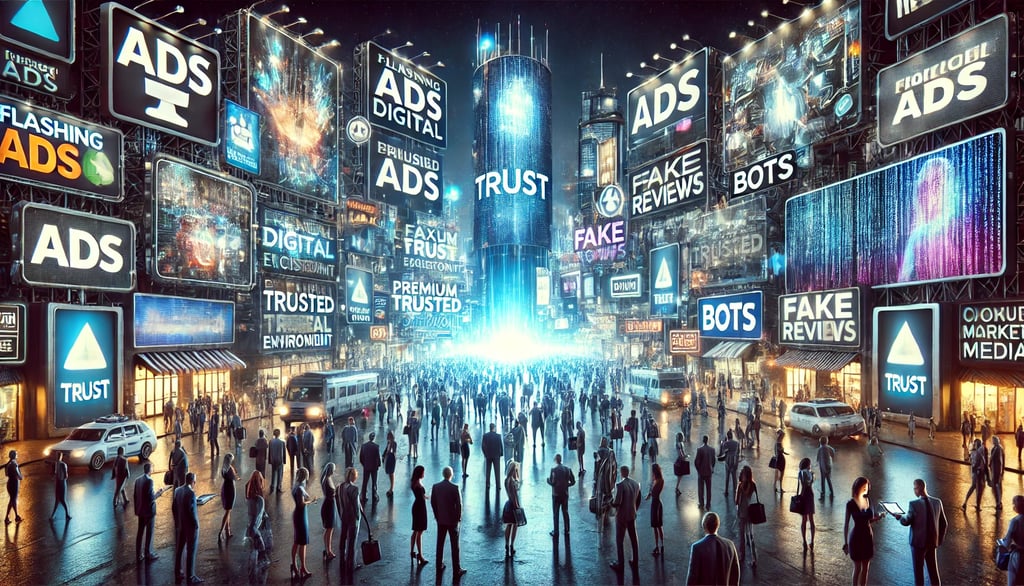
For a long time, consumer reviews have been one of the most powerful indicators of trust in the digital economy. They have helped reduce the information asymmetry between brands and consumers and introduced a form of collective validation into the purchasing decision. But this mechanism relies on one essential condition: credibility.
However, this credibility is now being undermined by the proliferation of fake reviews, poorly labeled sponsored content, and, more recently, content generated by artificial intelligence.
According to a Fakespot analysis of e-commerce reviews, a significant proportion of the reviews posted on certain major marketplaces show signs of being inauthentic. Meanwhile, in 2024, the U.S. Federal Trade Commission (FTC) tightened its rules against fake reviews and misleading testimonials, with fines of up to tens of thousands of dollars per violation.
In the United Kingdom, the Competition and Markets Authority (CMA) is taking a similar approach by requiring platforms to take greater responsibility for detecting and removing fraudulent reviews.
These regulatory changes reflect a growing realization: social proof has become too significant to remain unregulated. But the risk runs deeper.
When consumers begin to doubt reviews, it’s not just the credibility of the reviews that is affected. The entire trust mechanism becomes fragile.
Because if everything can be manipulated, then nothing really counts as proof anymore. And when social proof loses its credibility, it gradually ceases to be a competitive advantage and becomes mere background noise.
In this context, the issue is no longer simply about collecting reviews. The question becomes: how can we restore their credibility? In an environment saturated with unsubstantiated claims, the next key differentiator could come from verifiable evidence.
Influencer fatigue: when authenticity becomes a formula
In response to growing skepticism toward traditional advertising, brands have invested heavily in influencer marketing over the past decade.
The idea was simple: to replace the brands’ messaging with the voices of individuals.
Designers who are seen as more relatable to consumers.
Recommendations that come across as more authentic.
A more conversational approach to communication.
Over the past decade, this approach has indeed helped restore a degree of credibility. But as the marketing industry becomes increasingly industrialized, a new phenomenon is beginning to emerge: a form of saturation.
Audiences are now exposed to a growing volume of sponsored content, which is often highly formulaic and sometimes difficult to distinguish from one another.
According to several industry studies (including the Edelman Trust Barometer et GWI – GlobalWebIndex), consumers continue to value recommendations from people they perceive as authentic, but are becoming increasingly sensitive to the transparency of commercial partnerships.
It is not influence itself that is the problem. It is its normalization.
When authenticity becomes a marketing tool, it can gradually lose what made it valuable in the first place: its spontaneity. And when every recommendation can be sponsored, consumers naturally develop new critical instincts.
They no longer ask themselves just, “Is this interesting?” but also, “Is this sincere?”
This shift does not signal the end of influencer marketing. Rather, it marks its entry into a phase of maturity—a phase in which credibility can no longer rest solely on perceived proximity, but must be grounded in more solid indicators of trust.
Because in an environment where everything can become a source of influence, true differentiation may come from what remains genuinely credible. When authenticity becomes a formula, trust is no longer a given. It must be earned.
Attention Inflation: When Abundance Diminishes Impact
One of the advertising industry’s greatest achievements over the past two decades has been solving the problem of distribution. Thanks to digital technology, brands can now reach massive, precisely targeted audiences at optimized costs. It has never been easier to get a message out.
But this abundance has created a side effect that is rarely mentioned: information overload.
Every day, consumers are exposed to thousands of marketing messages:
display formats
social videos
influencer placements
notifications
retargeting
CTV
retail media
etc.
Advertising is no longer a rarity. It is everywhere. Yet in any economy, abundance tends to reduce perceived value.
This phenomenon is nothing new. Herbert Simon, a Nobel laureate in economics, had already explained that in an information economy, scarcity no longer pertains to information itself but to the available human attention.
Today, this insight has taken on a concrete reality: it is no longer exposure that is lacking. It is genuine attention.
According to several studies on advertising attention (including those by Lumen Research and Karen Nelson-Field / Amplified Intelligence), a significant proportion of digital ad impressions capture only a fraction of a second of actual attention.
In other words: an impression does not guarantee perception. And perception does not guarantee retention.
In this context, simply increasing the number of impressions is no longer enough to boost impact. It can even have the opposite effect: the message becomes trivialized. Because when everything grabs attention, nothing holds it for long.
This overload of information raises a fundamental strategic question for brands: how can they create value in a saturated environment?
The answer may no longer lie solely in the ability to reach audiences, but rather in the ability to be perceived as credible at the moment of exposure. For in an environment where attention is fragmented, trust could become one of the few drivers of impact.
In a saturated attention economy, visibility becomes a commodity. Credibility becomes a competitive advantage.
The obsession with performance: a strategic blind spot?
One of the major advances in modern advertising has been the introduction of a culture of measurement.
Attribution.
ROAS.
CPA.
Conversion.
Continuous optimisation.
Marketing has become more scientific, more data-driven, and more accountable. And this shift has yielded significant benefits.
But as is often the case with structural changes, this progress may also have created an imbalance. By focusing heavily on short-term, measurable performance, the advertising industry may gradually be underinvesting in what builds long-term effectiveness: trust.
Several academic and industry studies (notably those by Les Binet and Peter Field – IPA) have shown that strategies focused exclusively on short-term activation can undermine long-term brand-building efforts.
Performance delivers immediate results. Trust builds loyalty. And loyalty drives sustainable growth.
However, what is measurable is not always what matters most. Trust, perceived credibility, or a brand’s legitimacy are harder to quantify than clicks or conversions. But that doesn’t make them any less essential. On the contrary.
In a saturated and skeptical environment, they could once again become key determinants of advertising effectiveness. The question, then, is not whether to choose between performance and trust, but to recognize that performance without trust can become fragile.
Because an ad can lead to a conversion. But only trust can lead to lasting loyalty.
And in mature markets, preference is often the true driver of value. Performance can drive action, but trust drives preference. And preference creates lasting value.
Trust as a New Differentiator
While the past decade has been dominated by issues of targeting, distribution, and measurement, the coming decade could be marked by a return to a more fundamental factor: trust.
This is because, in an advertising ecosystem that has become extremely technically advanced, the gaps in raw performance between platforms are gradually narrowing.
Targeting capabilities are converging.
Optimization tools are becoming standardized.
Ad buying technologies are becoming more widely available.
In this context, differentiation could gradually shift—no longer focusing solely on technical performance, but rather on the quality of the environments in which the messages appear.
In other words: the credibility of the media landscape could once again become a strategic factor.
Several recent studies on brand safety and media quality (including those by Integral Ad Science, DoubleVerify, and WARC) show that environments perceived as trustworthy not only improve brand perception but also enhance audience attention and ad recall.
This trend reflects a profound shift: advertising could gradually transition from an economy of exposure to an economy of validation.
With this in mind, environments capable of providing credible signals of trust could become the most distinguishing factor. Because in the future, the question may no longer be simply: “How many people saw this message?” but rather: “In what context was this message perceived?” and “With what level of credibility?”
Toward a New Architecture of Advertising Trust
This development could restore a strategic role to media environments capable of offering:
credible editorial contexts
defined audiences
authentic interactions
real-world usage evidence
Because in a world where attention-grabbing signals are multiplying, signals of trust could become the rarest of all. And as is often the case in the digital economy: what becomes rare becomes strategic.
The next frontier in advertising may not be technological. It could be relational.
Attention makes things visible. Trust makes things credible.
Our commitment
Reviving trust in brand advertising through innovation.
CONTACt
info@buytryshare.com
+33 6 83 53 70 41
© 2025. SLB consulting. All rights reserved.